A new software update can change how a car drives, but it can also change what drivers believe.
Big Tech & AI · EP54
Tesla FSD v15: What Really Changed?
The first rollout brings Reality View and practical updates, while Tesla's safety claim still needs context.
Free membership
Sign up free to unlock this episode.
After you log in, every lesson is 100% free — full audio, interactive transcript, expressions, and speaking practice. No paid plan.
- Unlimited access to the full episode library
- Synced transcripts and key expressions
- Save favorites and build your word list
Two newest episodes stay open for guests so you can try Atoz first.
Ready. Select a line to jump into the episode.
Tesla has begun rolling out Full Self-Driving version fifteen, one of its biggest recent updates.
The first wave started on November twenty-first, so many owners have not received it yet.
Tesla describes a new driving network, a new screen view, and several practical features.
The real question is simple: what has changed, and what still needs proof?
In an earlier episode, we examined why the last one percent of driving is so hard.
Today, we are looking at the specific claims and features of this new release.
Start with the screen, because that is the change drivers may notice first.
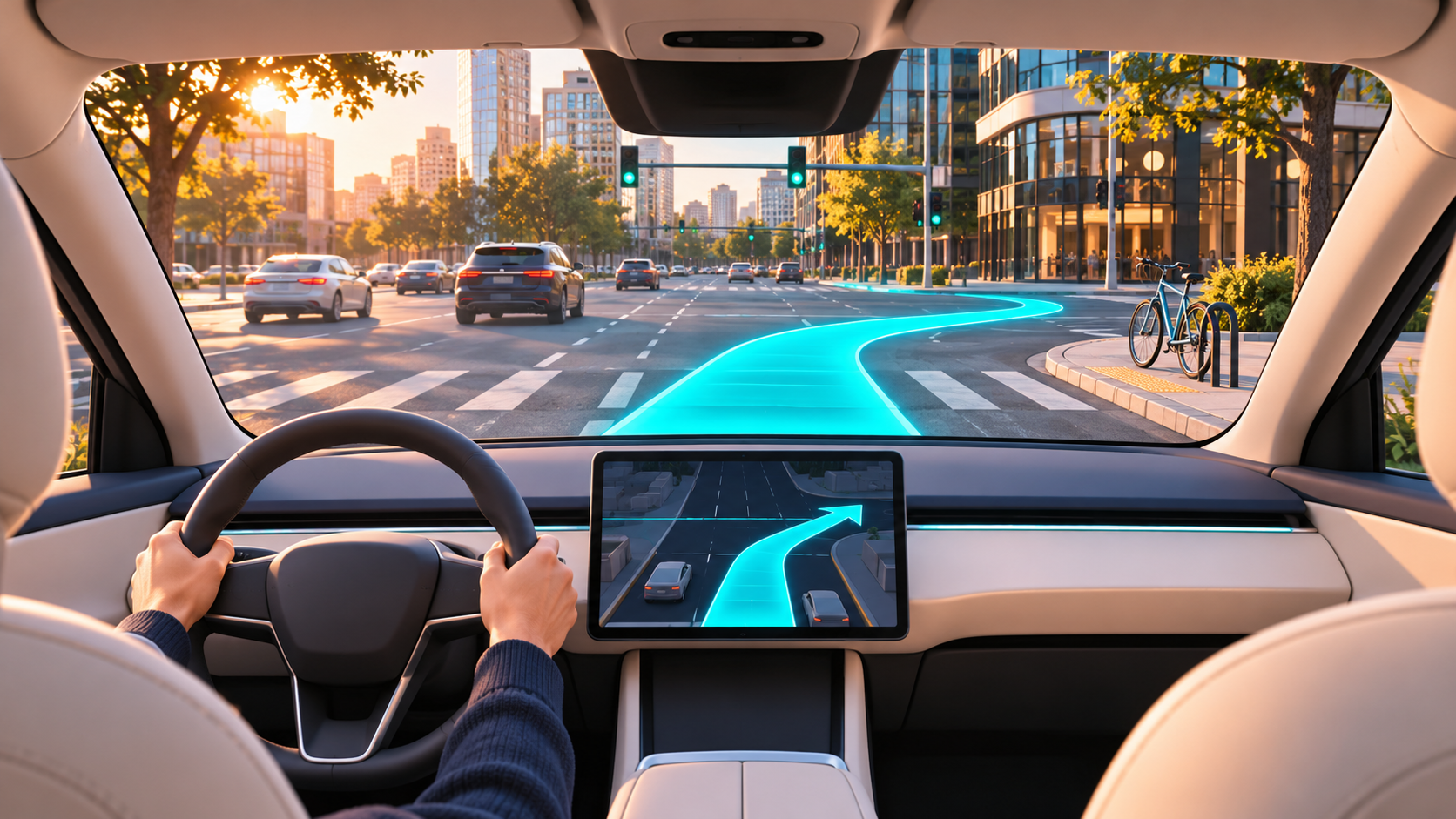
Tesla calls its new live visualization Reality View.
It shows a generated view of the road and the path the car plans to take.
Imagine approaching a complicated intersection and seeing the intended turn before the car makes it.
That could make the system easier to understand in the moment.
But a clear picture on a screen does not prove the car understands every hazard.
A visualization communicates a plan; the car still has to execute that plan safely.
The display is useful if it helps a driver notice a mistake early.
It becomes risky if its polished appearance creates more confidence than the evidence supports.
The deeper change is inside the driving software.
Tesla says version fifteen upgrades every part of its end-to-end driving network.
It also says a new vision system learns from a much wider collection of video.
In plain language, Tesla wants the car to recognize unfamiliar scenes and respond more reliably.
That goal matters most when a road does not match the usual pattern.
Think of standing water hiding a lane marking or debris beside a narrow exit.
Tesla says drivers should notice better recognition of signs, animals, potholes, and those obstacles.
It also promises more natural speed choices near schools and in difficult weather.
These are release claims, not a complete record of performance across every road.
One number in the announcement deserves a closer look.
Tesla says version fifteen handles safety-critical cases twenty-five times better.
Its release notes connect that figure to a lower rate of critical driver interventions.
An intervention is when a human steps in because the driving system needs help.
That sounds promising, especially if the improvement holds outside development testing.
Yet Tesla has not published enough detail with the announcement to independently check the comparison.
We need to know which roads, weather, vehicles, drivers, and software versions were included.
We also need the starting rate, the ending rate, and how a critical intervention was defined.
Without those details, twenty-five times better is a company claim, not a verified safety result.
It does not mean twenty-five times fewer crashes.
A crash rate and an intervention rate measure different things.
And a rare event can look different when the driving environment changes.
This does not dismiss the claim; it tells us what evidence would make it stronger.
Now consider the smaller changes that could affect an ordinary trip.
Tesla says the car can slow for speed cameras, while the driver remains responsible for speed.
A new Bike Rack Mode is designed for a bike rack or similar hitch accessory.
Tesla also says version fifteen can learn route preferences near the start and end of trips.
Later versions are meant to extend that learning across the full route.
For someone who takes the same driveway and awkward turn each day, that could feel personal.
But learning a preference is different from proving every chosen maneuver is safe.
Drivers should still watch the road, especially around pedestrians, bikes, and unexpected traffic.
Another important detail is who can actually use this update.
A rollout happens in stages, and access can depend on hardware, software, and region.
A video from an early owner cannot tell every driver when their own car will receive it.
Nor can one smooth trip show how the system performs in heavy rain or unusual construction.
Early footage can reveal interesting behavior, but it is a small sample.
The next useful evidence will come from many miles and many different conditions.
We should look for clearly defined intervention data and independent checks of the results.
We should also ask whether drivers can understand the new display without becoming distracted.
The most important boundary has not changed with the version number.
Tesla still calls the product Full Self-Driving Supervised.
Its own guidance says the driver must remain attentive and ready to take control.
The update does not make a privately owned Tesla an autonomous car.
A driver cannot treat Reality View as permission to look away from the road.
That distinction matters because the human is still part of the safety system.
So what should we take away from version fifteen today?
It brings a clearer view of the car's intended path and several practical driving features.
Tesla also describes a major change to the system that interprets video and plans movement.
Those changes may make daily driving feel more capable for some early users.
But the headline safety figure needs its method and a wider body of evidence.
The best test is whether improvement remains consistent across ordinary trips and difficult surprises.
Progress in driver assistance is real only when drivers can rely on it within clear limits.
That's all for today's episode.
Version fifteen is an important update, and its most ambitious claims still need careful measurement.
Thanks for listening, and we'll see you next time.
Speaking practice
Speak It Out
Consider the new features and evidence.
Recording is off. Click a question to play it.
Which FSD version fifteen feature would be most useful to a driver, and why?
Click to play
What evidence would help you judge Tesla's safety claim more confidently?
Click to play
Key Expressions
deserves a closer lookshould be examined more carefully
thoughtful
- examining a claim
- reviewing a result
One number in the announcement deserves a closer look.
within clear limitsonly when the boundaries of use are understood
careful
- discussing safety
- setting expectations
Drivers can rely on the system within clear limits.
a small sampletoo few examples to represent all cases
analytical
- evaluating early reports
- comparing evidence
Early footage is a small sample.