The Tesla Roadster is often described with numbers that sound almost unreal.
Big Tech & AI · EP46
Big Tech & AI: Why the Tesla Roadster Still Matters
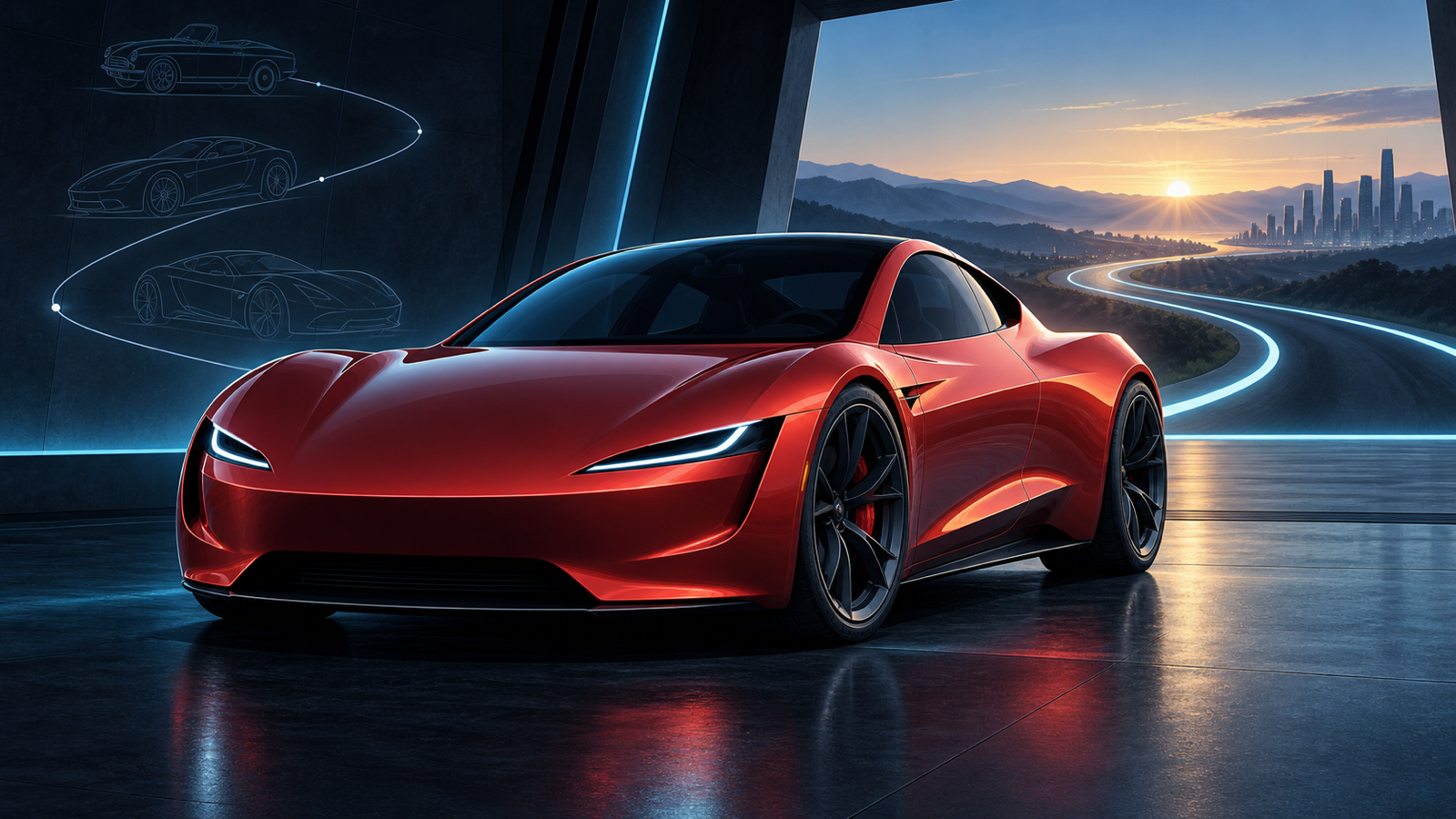
The Roadster matters less as a sales machine than as Tesla's halo car, technology laboratory, and symbol of driving in an autonomous future.
Free membership
Sign up free to unlock this episode.
After you log in, every lesson is 100% free — full audio, interactive transcript, expressions, and speaking practice. No paid plan.
- Unlimited access to the full episode library
- Synced transcripts and key expressions
- Save favorites and build your word list
Two newest episodes stay open for guests so you can try Atoz first.
Ready. Select a line to jump into the conversation.
Tesla currently advertises a zero-to-sixty time of 1.9 seconds, a top speed above 250 miles per hour, and 620 miles of range.
Those figures are targets on Tesla's product page, not independently verified specifications for a production car.
But the most important question is not whether the Roadster wins a drag race.
The deeper question is why Tesla still needs this car at all.
Tesla now sells family vehicles, builds charging infrastructure, develops autonomous driving, and works on robots and energy storage.
A small electric supercar may look like a distraction from those larger goals.
I think the opposite may be true.
The Roadster could be valuable because it explains what kind of company Tesla still wants to be.
To understand that value, we need to return to Tesla's beginning.
The original Roadster entered regular production in 2008, when electric cars were widely treated as slow and limited.
It used sports-car performance to make a practical argument about a new technology.
People did not need to admire battery chemistry before they understood rapid acceleration.
The car made electric power emotional before Tesla made it mainstream.
Tesla later said the early Roadster also provided a real-world test fleet for improving its electric powertrain.
That combination is important: desire attracted attention, while engineering experience supported the next products.
The first Roadster was therefore more than a luxury toy.
It was a bridge between an unlikely idea and a mass-market company.
A new Roadster would return Tesla to that original formula after the company became enormous.
In the auto industry, a halo car is not expected to produce the highest sales volume.
Its job is to make the entire brand feel more capable and desirable.
A dramatic sports car can pull attention toward ordinary models that share part of its technology or identity.
Tesla may need that effect more than it did a few years ago.
Electric acceleration is no longer surprising, and many competitors now offer polished electric vehicles.
Tesla has also expanded into products whose appeal is based on utility, automation, and scale.
Those ambitions are important, but they do not always create the same emotional connection as a beautiful machine.
The Roadster can remind people that efficiency and excitement do not have to be opposites.
If it looks special and performs convincingly, it can create a halo over the whole Tesla lineup.
That halo may matter even if the Roadster itself remains rare.
The second source of value is engineering transfer.
A supercar pushes batteries, motors, inverters, cooling, aerodynamics, tires, and software toward difficult limits.
Maintaining high performance is harder than producing one spectacular burst of acceleration.
Heat must be controlled, power delivery must remain predictable, and the vehicle must still feel safe.
Long range creates another challenge because extra battery capacity usually adds weight.
A removable glass roof and four-seat claim add packaging problems that pure race cars can ignore.
Solving these conflicts can produce knowledge that later reaches less expensive vehicles.
Not every Roadster component will move directly into a Model Y.
However, better thermal systems, lighter structures, and more efficient power electronics can influence future platforms.
The Roadster can function as a public research project whose lessons travel beyond the car.
There is also a less obvious value that may become more important over time.
Tesla's future story increasingly emphasizes vehicles that drive themselves.
In that world, transportation becomes a service that removes effort and returns time to the passenger.
The Roadster represents the opposite pleasure: choosing to drive when driving is no longer necessary.
That does not make it anti-technology.
It makes human control a premium experience rather than an everyday burden.
A mechanical watch remains desirable even when a phone keeps better time.
In the same way, an engaging car may become more emotionally valuable when most travel becomes automated.
The Roadster could preserve a place for curiosity, skill, and personal agency inside Tesla's automated future.
That tension gives the product meaning beyond speed.
Of course, symbolism cannot replace delivery.
Tesla unveiled the second-generation Roadster in 2017, and the wait has lasted far longer than originally expected.
Tesla's official page still accepts reservations but does not provide a firm production date.
A 2025 regulatory filing listed the Roadster as in development with its manufacturing location still to be determined.
Every additional promise therefore increases the burden on the final product.
A normal sports car could be impressive and still feel disappointing after such a long delay.
The Roadster must show that the waiting created a real technological leap rather than a permanent moving target.
It must also work as a complete car, not only as a demonstration of one dramatic feature.
Handling, braking, repeatable performance, comfort, safety, and build quality will matter beside acceleration.
Trust may be the Roadster's hardest performance measurement.
If Tesla succeeds, the Roadster will not simply be the fastest Tesla.
It will connect the company's past to its future.
It will recall the small sports car that made electric driving desirable, while testing technology for an era of automation.
It can give Tesla a halo product, an engineering laboratory, and an emotional counterweight to autonomous transportation.
The car does not need to sell in Model Y numbers to create that value.
It needs to make people believe that Tesla can still build something no other company would attempt in quite the same way.
That is why the Roadster still matters.
Its greatest test is not whether it can reach sixty miles per hour in less than two seconds.
Its greatest test is whether Tesla can turn a long-running promise into a convincing object.
That's all for today's episode.
The Roadster could make driving itself feel precious in a future built around autonomy.
Thanks for listening, and we'll see you next time.
Speaking practice
Speak It Out
Think about what makes an ambitious product valuable.
Recording is off. Click a question to play it.
Which matters more for the Roadster: extreme performance, technology transfer, or its effect on the Tesla brand, and why?
Click to play
Would driving become more valuable to you if most transportation became autonomous? Explain your view.
Click to play
Key Expressions
more than a luxury toysomething has practical or strategic value beyond entertainment or status.
neutral
- products
- strategy
The prototype became more than a luxury toy.
push something toward its limitstest or develop something under very demanding conditions.
neutral
- engineering
- performance
A supercar pushes battery cooling toward its limits.
raise the burden of proofmake stronger evidence necessary before people will believe a claim.
analytical
- promises
- credibility
Repeated delays raise the burden of proof.