Christopher Nolan's The Odyssey begins with a man trying to get home.
Movie & Culture · EP21
Movie & Culture: Before The Odyssey — The War at Troy
The Trojan War, Achilles, and the choices that sent Odysseus on his long journey home
Ready. Select a line to jump into the conversation.
But to understand why that journey matters, we need to look at the war he is leaving behind.
That war is the Trojan War, the legendary conflict that brought together Achilles, Hector, Agamemnon, and Odysseus.
Many modern viewers first met that world through Wolfgang Petersen's film Troy, released in 2004.
The film turns an enormous body of myth into a grounded story about pride, power, love, and the cost of war.
It is not a perfect map of the ancient poems, but it gives us a useful entrance into the world before The Odyssey.
The basic conflict begins with Helen, the queen of Sparta, and Paris, a prince of Troy.
Paris takes Helen to Troy, although different versions describe her departure in different ways.
Her husband, Menelaus, wants her returned.
His brother Agamemnon sees something larger: a reason to unite the Greek kings and attack a wealthy rival city.
In Troy, this political ambition sits behind the language of honor.
Thousands of soldiers cross the Aegean, but they are not all fighting for the same reason.
Some follow duty, some seek wealth, and some want their names to survive long after their deaths.
No one represents that desire for glory more clearly than Achilles.
He is the greatest Greek warrior, nearly unstoppable in battle and deeply suspicious of Agamemnon's authority.
Achilles does not simply obey because a king gives an order.
He wants honor on his own terms, and he knows that fame may cost him a long life.
Odysseus is different.
He is the king of Ithaca, a husband, a father, and a skilled negotiator.
Where Achilles is defined by force, Odysseus is defined by judgment, language, and strategy.
In the 2004 film, it is Odysseus who visits Achilles and persuades him to join the campaign.
Their conversation reveals the central tension between them.
Achilles wants immortal fame, while Odysseus understands that kings and soldiers must live with the consequences of ambition.
They are allies, but they embody two very different kinds of heroism.
The ancient tradition gives their relationship even more background.
In later stories, Achilles is hidden on the island of Skyros because his family knows he may die at Troy.
Odysseus discovers him through a clever test and helps bring him into the Greek army.
This is important because Odysseus does not defeat the strongest man.
He understands him.
That ability to read people will become one of Odysseus's most powerful weapons.
The most famous part of the war is the conflict between Achilles and Hector.
Hector is Troy's greatest defender, but he is also a son, husband, and father trying to protect his city.
Achilles withdraws from battle after a bitter dispute with Agamemnon.
The Greeks suffer without him, and Achilles's companion Patroclus eventually enters the fighting wearing his armor.
Hector kills Patroclus, believing at first that he has faced Achilles.
Grief pulls Achilles back into the war.
He kills Hector and treats the body with shocking cruelty before Hector's father, King Priam, comes to beg for his son.
That meeting is one of the emotional centers of the Iliad.
For a moment, two enemies recognize the same human grief.
The Iliad does not actually tell the whole Trojan War.
It focuses on a short period during the final year of the siege, especially the anger of Achilles.
It ends before Achilles dies and before the wooden horse enters Troy.
The familiar complete story comes from a larger tradition of poems, legends, and later retellings.
This is where Troy the film takes major liberties.
It removes the gods and presents the conflict as if human politics alone drive every event.
It compresses a legendary ten-year war into a much shorter campaign.
It also changes several relationships and deaths to create one continuous dramatic story.
Those choices make the film easier to follow, but they should not be mistaken for either Homer's exact version or proven history.
Archaeology shows that a real city stood at the site associated with Troy in what is now Türkiye.
That city was destroyed and rebuilt multiple times.
Yet archaeology cannot prove that Helen caused a vast Greek invasion or that a giant wooden horse opened the gates.
Troy is best understood as a place where history, memory, poetry, and myth overlap.
After years of failed attacks, strength is no longer enough to defeat the city.
The Greeks need an idea, and tradition gives that idea to Odysseus.
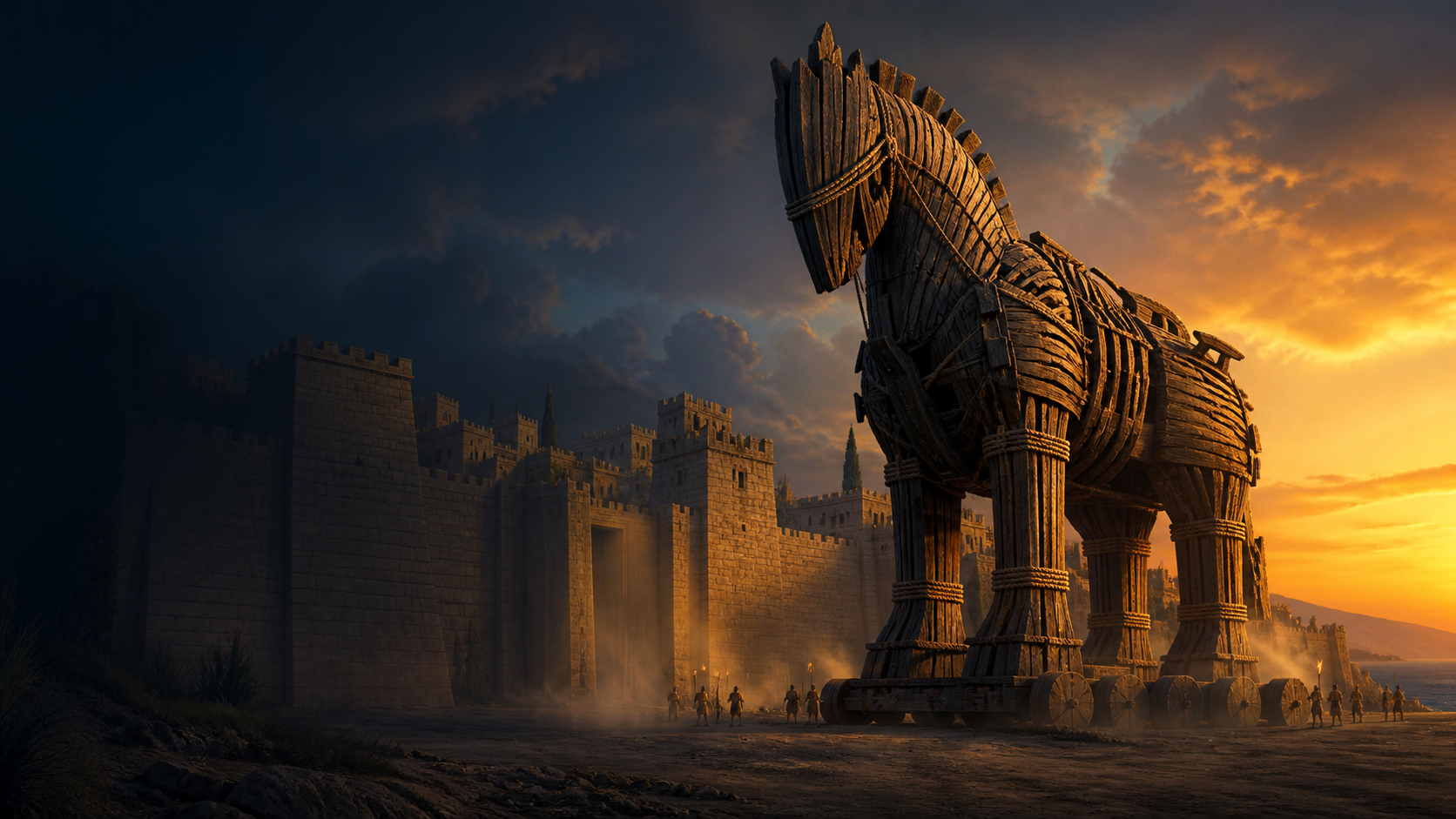
They construct a giant wooden horse, hide selected warriors inside, and pretend to sail away.
The Trojans bring the horse behind their walls as a trophy.
At night, the hidden Greeks emerge, open the gates, and allow the army to enter.
Troy falls not because Achilles wins one more duel, but because Odysseus changes the nature of the contest.
The story moves from battlefield strength to deception and intelligence.
That shift prepares us for The Odyssey.
Odysseus has helped end the war, but victory does not bring peace.
The destruction of Troy leaves violence, broken families, angry gods, and exhausted survivors on both sides.
The Greek leaders begin separate journeys home, known in ancient tradition as the Returns.
Some reach home quickly, some return to disaster, and Odysseus is delayed for ten more years.
His greatest quality remains his intelligence, but it can also become pride.
He survives monsters, storms, temptation, captivity, and the consequences of revealing too much about himself.
The hero who outsmarted Troy must learn that cleverness alone cannot control the world.
This is why knowing the Trojan background changes the way we see The Odyssey.
Odysseus is not beginning as an innocent traveler who gets lost.
He is a veteran king returning from a brutal war that he helped win through deception.
He carries experience, responsibility, and perhaps guilt across the sea.
Achilles also remains an important contrast, even after his death.
Achilles chooses a short life with eternal fame.
Odysseus spends his story fighting to recover an ordinary human life with Penelope and Telemachus.
One hero becomes unforgettable by dying at Troy.
The other becomes unforgettable by refusing to disappear before he reaches home.
If you watch Troy before The Odyssey, notice where one kind of epic ends and another begins.
The burning city, the wooden horse, and the fallen warriors are not just background decoration.
They explain the world Odysseus is escaping, the reputation he carries, and the difficult person he has become.
That's all for today's episode.
The Odyssey is a journey home, but the road begins in the final shadows of Troy.
Thanks for listening, and we'll see you next time.
Speaking practice
Speak It Out
Click a question to practice speaking after the episode. Turn on recording if you want to review your answer.
Recording is off. Click a question to play it.
How does knowing about the Trojan War change the way you understand Odysseus at the beginning of his journey home?
Click to play
Achilles represents strength and lasting fame, while Odysseus represents strategy and survival. Which kind of heroism interests you more, and why?
Click to play