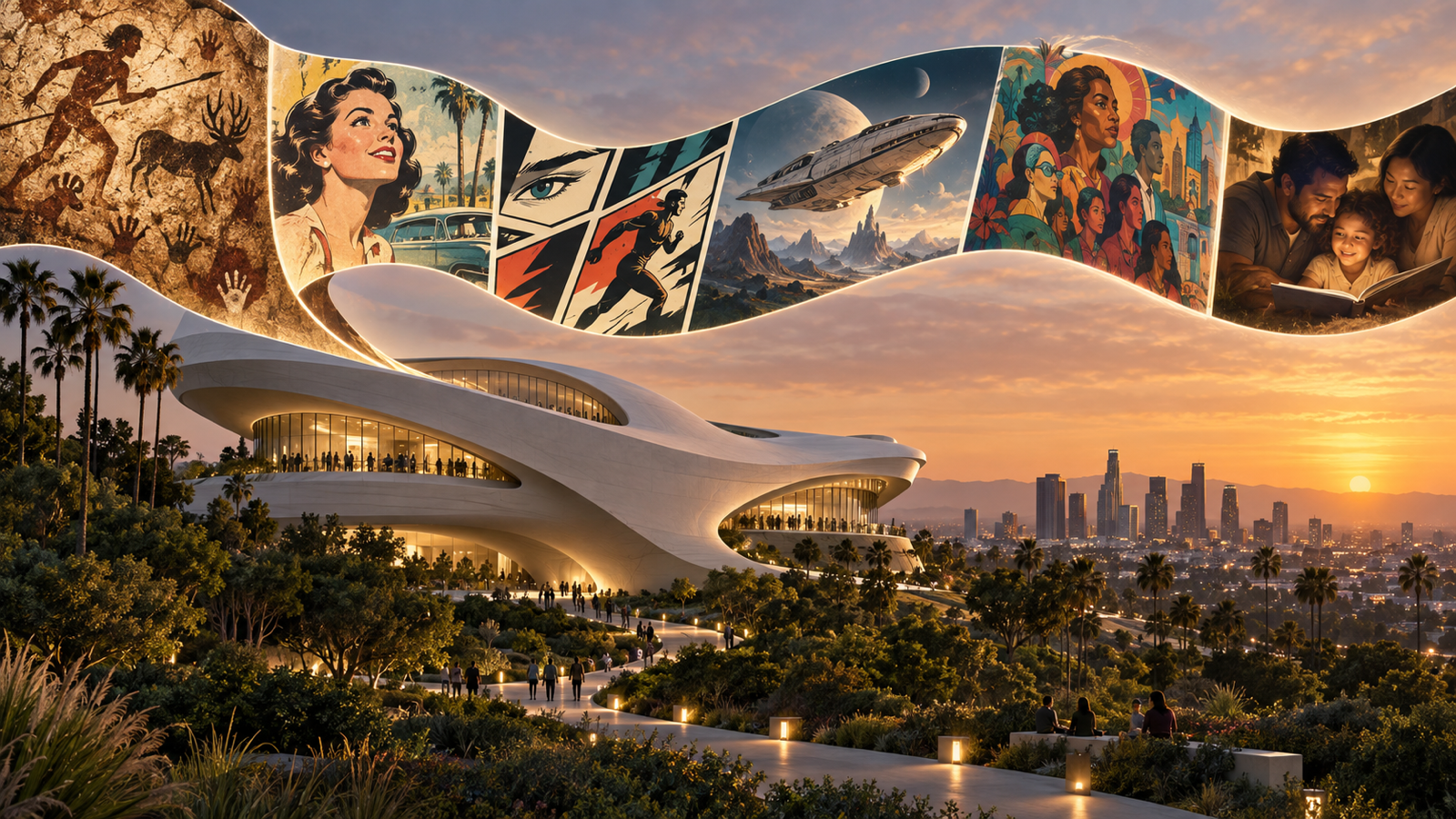
Tomorrow, a strange white building in Los Angeles will finally open its doors.
Movie & Culture · EP47
Movie & Culture: George Lucas Built a Museum for the People's Art
The Lucas Museum is not simply a home for film objects. It challenges the boundary between fine art and the popular images that shape collective memory.
Free membership
Sign up free to unlock this episode.
After you log in, every lesson is 100% free — full audio, interactive transcript, expressions, and speaking practice. No paid plan.
- Unlimited access to the full episode library
- Synced transcripts and key expressions
- Save favorites and build your word list
Two newest episodes stay open for guests so you can try Atoz first.
Ready. Select a line to jump into the conversation.
It is the Lucas Museum of Narrative Art, founded by filmmaker George Lucas and business leader Mellody Hobson.
Because Lucas created Star Wars, many people will naturally expect a Star Wars museum.
They will find spacecraft models and other objects from cinema, but that is only a small part of the collection.
The museum places cave paintings, magazine covers, comic art, murals, children's books, photography, and film design inside one long human story.
That makes it more than a tribute to a famous director.
It is an argument about which images deserve to be called art.
I think this may be one of the most revealing projects of Lucas's later career.
The museum uses the phrase narrative art for images that tell stories.
Some show a clear event, while others suggest a character, a conflict, or an entire world.
We meet these images in museums, but also in newspapers, advertisements, comic books, movie theaters, and family homes.
They teach us what a hero looks like, what success looks like, and whose experiences appear important.
In that sense, visual storytelling does more than entertain us.
It helps create our collective memory.
The museum organizes much of its art around familiar themes such as love, family, work, childhood, sports, adventure, and community.
The goal is not to begin with a technical art movement.
It is to begin with experiences that almost anyone can recognize.
Traditional museums have often placed fine art above commercial illustration, comics, posters, and production design.
A painting made for a gallery could earn institutional recognition, while an image seen by millions on a magazine cover might be treated as less serious.
Lucas is challenging that cultural hierarchy.
His collection includes recognized artists such as Frida Kahlo and Norman Rockwell, but it also makes room for images created for popular audiences.
The message is not that every popular image is a masterpiece.
The message is that popularity should not automatically disqualify an image from careful study.
A comic panel can express movement, fear, and moral choice with extraordinary precision.
A movie concept drawing can shape how millions imagine the future.
A magazine illustration can reveal the hopes and prejudices of its time.
These works helped build a shared visual language, even when the art world ignored them.
The museum also tells a story about persistence.
Lucas and Hobson developed the idea for roughly seventeen years before the opening.
Earlier plans in San Francisco and Chicago failed, and the project eventually found a home in Exposition Park in South Los Angeles.
The final institution reportedly cost about one billion dollars.
Its flowing building was designed by Ma Yansong, while the surrounding landscape was designed by Mia Lehrer and Studio-MLA.
The campus covers thirteen acres and includes a museum with about one hundred thousand square feet of gallery space.
More than thirty galleries will display over thirteen hundred works in the opening exhibitions.
Behind them is a permanent collection of more than forty thousand objects.
Those numbers show that this is not a celebrity's private collection placed in a decorative building.
It is an attempt to create a lasting public institution.
Star Wars is present, and it should be.
The films combined old mythology, experimental filmmaking, industrial design, sound, and new visual technology.
They proved that popular entertainment could build a modern mythology shared across countries and generations.
But the museum makes a smart choice by placing those objects beside much older and broader traditions.
A cinematic costume becomes part of the same human impulse that produced ancient figures, painted legends, and illustrated adventures.
This context makes Star Wars more interesting, not less important.
It asks us to study how stories travel between media and across centuries.
Lucas is no longer only creating a world for an audience.
He is showing the cultural family that helped make that world possible.
That leads to the deeper value of this museum.
Lucas spent his career using technology to expand what filmmakers could show on a screen.
Now he is using an institution to expand what museums are willing to show on a wall.
The tools are different, but the underlying project is surprisingly consistent.
Both efforts blur the boundary between elite culture and mass entertainment.
Both ask new technology or new architecture to serve an ancient human need for stories.
And both depend on taking images seriously before traditional gatekeepers fully accept them.
Seen this way, the museum is not a retirement hobby after filmmaking.
It is Lucas's second act as a builder of cultural infrastructure.
Of course, broadening the canon does not remove curatorial power.
Someone still chooses which popular images enter the museum and which remain outside.
A huge personal collection also reflects the taste and resources of its founders.
Visitors should therefore ask not only what is included, but also what voices may still be missing.
That question does not weaken the museum's mission.
It makes the mission more honest.
Every museum tells a story through selection, sequence, lighting, labels, and space.
The Lucas Museum simply makes storytelling itself the subject of that process.
Its success will depend on whether different communities can see themselves as participants rather than just spectators.
The most valuable question inside this museum may not be, is this fine art?
A better question is, what did this image teach me to see?
That question works for a famous painting, a comic-book page, a film prop, or an illustration from childhood.
It directs our attention away from prestige and toward influence.
George Lucas became famous by understanding that images can live in memory for decades.
Now he and Mellody Hobson have built a museum around that simple but powerful fact.
If the institution works, visitors may leave with more respect for the visual stories already surrounding them.
They may also become more careful about the stories those images continue to tell.
That's all for today's episode.
The Lucas Museum asks us to judge art not only by where it hangs, but by how deeply it enters our shared imagination.
Thanks for listening, and we'll see you next time.
Speaking practice
Speak It Out
Think about which images deserve to be taken seriously.
Recording is off. Click a question to play it.
Which kinds of popular images do you think museums should take more seriously, and why?
Click to play
Do you think a museum can change what society considers art? Explain your view.
Click to play
Key Expressions
more than a tribute tosomething has a broader purpose than simply honoring a person or achievement.
neutral
- culture
- projects
The exhibition is more than a tribute to one filmmaker.
blur the boundary betweenmake the difference between two categories less clear.
analytical
- culture
- technology
Digital tools blur the boundary between film and games.
earn a place inbecome accepted as worthy of inclusion in a group or institution.
neutral
- recognition
- culture
Popular illustration has earned a place in serious museums.