On August twelfth, a thin path across the planet will go dark in the middle of the day.
Science & Future · EP16
Science: The August 12 Total Eclipse
A monologue on totality, rare midday darkness, and why people chase two minutes
Ready. Select a line to jump into the conversation.
Not because of a storm.
Not because of smoke.
Because the Moon will slide directly in front of the Sun.
That is a total solar eclipse.
And for people standing in the right place, the world can change in seconds.
Daylight fades.
The temperature drops.
Birds may go quiet.
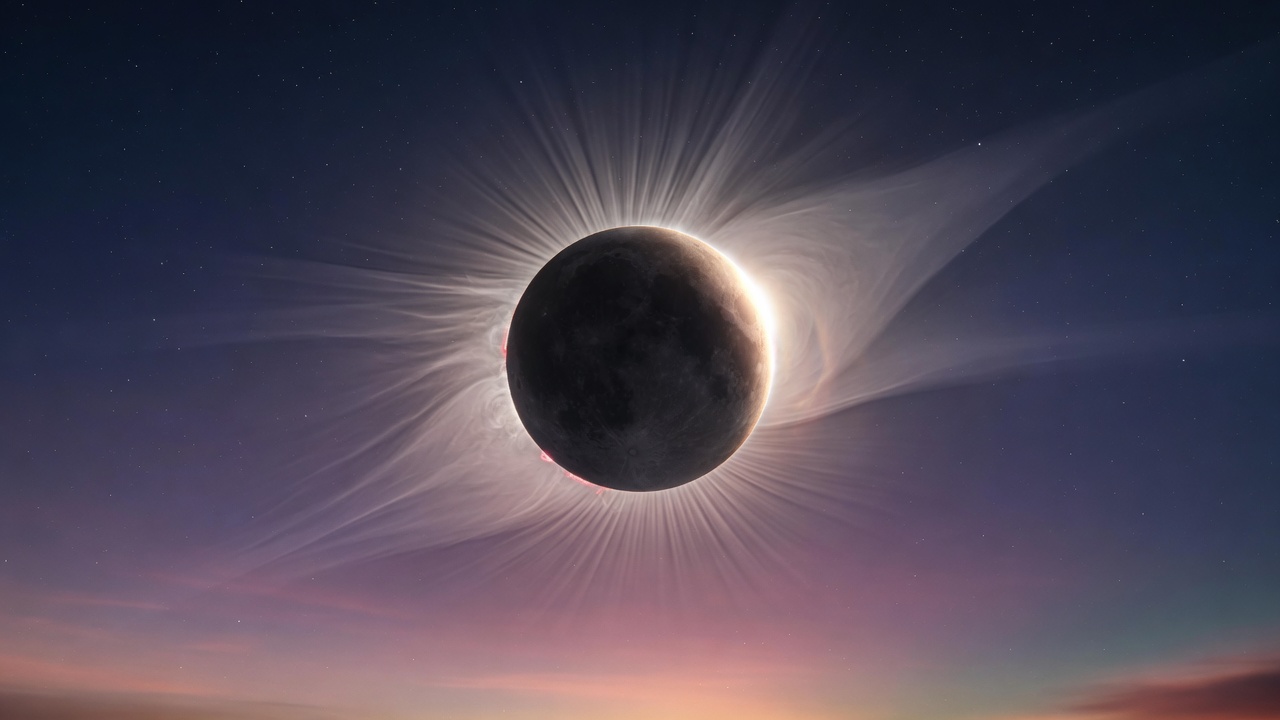
And for a short window, the Sun's outer atmosphere, the corona, becomes visible around a black disk.
That window is short.
Totality often lasts only one or two minutes in many locations.
That is why the date matters so much.
August twelfth is not just another astronomy headline.
It is a rare chance to experience night falling at midday.
The path of totality is expected to cross parts of the North Atlantic region, including places such as Greenland, Iceland, and Spain.
Outside that narrow path, many people will still see a partial eclipse.
The Sun will look like a bite has been taken out of it.
But only inside the path of totality does the full drama appear.
That difference explains the travel boom around eclipses.
People do not fly across continents for a partial view alone.
They chase totality.
Hotels fill up.
Flights rise in price.
Small towns suddenly become destinations.
All for a few minutes under a dark sky.
Scientifically, an eclipse is also useful.
It lets researchers study the Sun's outer layers more clearly.
It is a natural laboratory that no satellite can fully replace for every observer on the ground.
But the public story is not only about research papers.
It is about attention.
In a world full of screens, a total eclipse is one of the few events that still forces people to look up together.
Strangers share glasses.
Families stand in parking lots.
Cities pause.
For two minutes, the ordinary schedule loses its power.
There is also a practical side.
Looking at the Sun without proper eye protection is dangerous, except during the brief phase of totality when the bright surface is completely covered.
Weather matters too.
Clouds can hide the whole show.
That uncertainty is part of the chase.
You can plan for years and still lose the view to one gray morning.
So why do people still go?
Because the memory is unusually strong.
Many travelers say a total eclipse feels less like watching the sky and more like standing inside a special kind of silence.
Streetlights may switch on.
The horizon can glow like sunset in every direction.
And then, almost abruptly, day returns.
That sudden return is part of the shock.
The darkness does not linger long enough to become normal.
It arrives, it holds the world, and it leaves.
That is why August twelfth is worth understanding now, before the date arrives.
It is not only a calendar event.
It is a reminder that the solar system still stages moments larger than our daily news cycle.
Rockets, markets, and phones will keep moving.
But for a short path across Earth, the oldest clock in the sky will take the lead.
That's all for today's episode.
Sometimes the most powerful story is only two minutes long.
Thanks for listening, and we'll see you next time.
Speaking practice
Speak It Out
Click a question to practice speaking after the episode. Turn on recording if you want to review your answer.
Recording is off. Click a question to play it.
Would you travel a long distance for only one or two minutes of totality? Why or why not?
Click to play
A total eclipse is both a science event and a human experience. Which side is more interesting to you, and what would you want to notice if you saw one?
Click to play