NVIDIA's greatest success began with a failure that almost killed the company.
Stories · EP28
Stories: Jensen Huang's 30-Year Bet
The wrong turn, the one-shot comeback, and the software bet behind NVIDIA
Free membership
Sign up free to unlock this episode.
After you log in, every lesson is 100% free — full audio, interactive transcript, expressions, and speaking practice. No paid plan.
- Unlimited access to the full episode library
- Synced transcripts and key expressions
- Save favorites and build your word list
Two newest episodes stay open for guests so you can try Atoz first.
Ready. Select a line to jump into the conversation.
Today, we're looking at how Jensen Huang turned one wrong technical bet into a thirty-year advantage.
This is not a story about a leader who always knew the future.
It is a story about changing direction when the facts change, then staying committed when a difficult idea begins to work.
Today, Jensen Huang is one of the best-known leaders in technology.
NVIDIA's chips help run video games, scientific research, data centers, and modern artificial intelligence.
But the company did not begin with AI.
In its early years, it was a small business trying to survive in a crowded graphics market.
In 1993, Huang met two engineers at a Denny's restaurant in California.
They believed personal computers would become much more visual.
Games would need richer worlds, smoother movement, and more realistic images.
That idea had promise, but many other companies saw the same opportunity.
NVIDIA had little money, no famous product, and no safe path forward.
Huang had moved from Taiwan to the United States as a child.
Long before he became a chief executive, he worked as a dishwasher and waiter.
Those jobs did not teach him chip design.
But they taught him to work under pressure, solve immediate problems, and pay attention to what people actually needed.
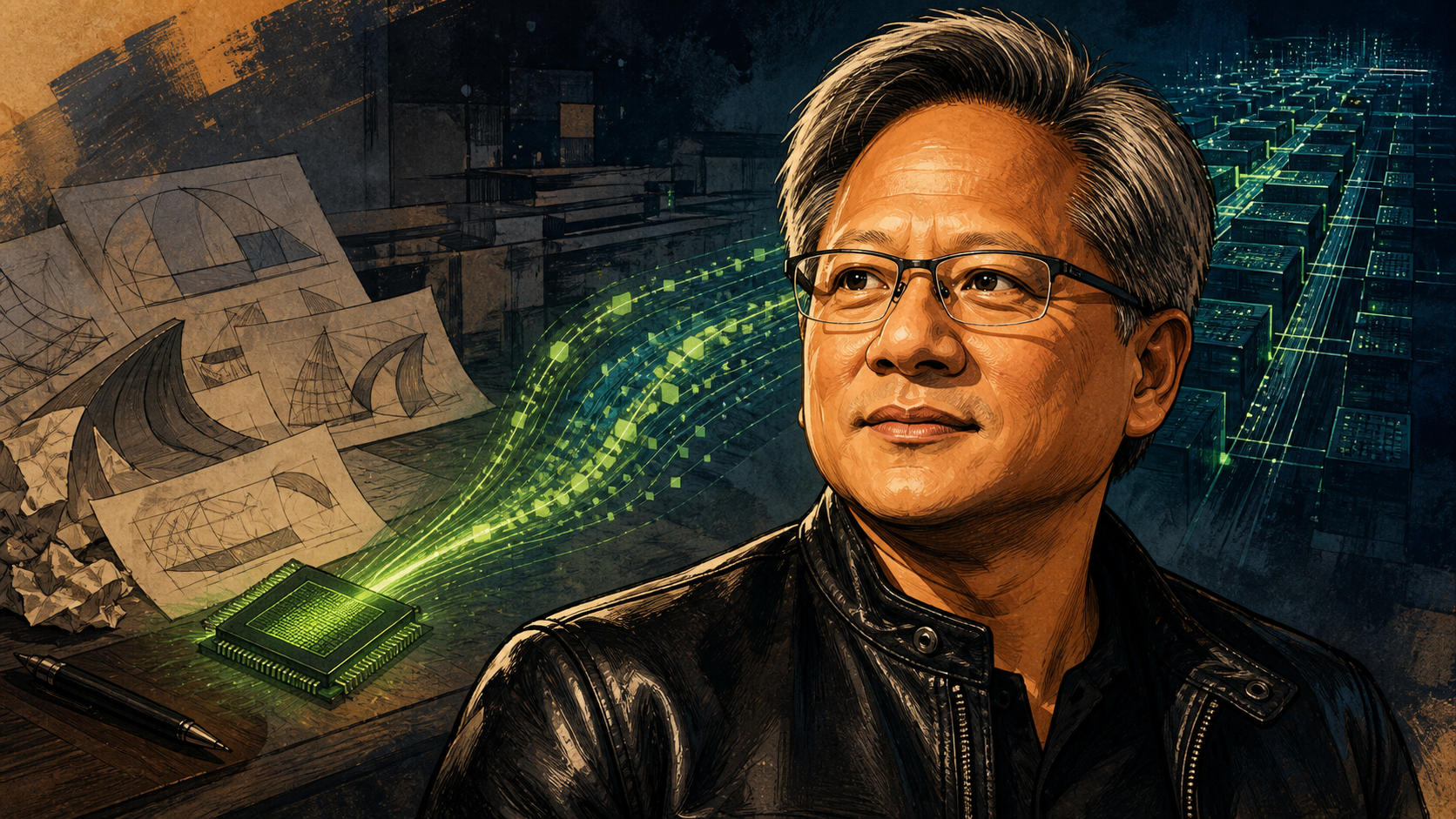
NVIDIA's first major chip was called the NV1.
It tried to produce three-dimensional graphics with curved surfaces.
The approach was creative, and the Japanese game company Sega became an important customer.
For a young company, that partnership looked like a major victory.
Then the market moved in another direction.
Microsoft introduced graphics tools built mainly around triangles, not NVIDIA's curved shapes.
Triangles may sound like a small technical detail.
They were not.
Game makers needed a common language.
If most developers used triangles, a chip built around another system became harder to support.
Huang later said NVIDIA had made three important technical choices, and all three were wrong.
The team could keep defending its original design.
It could finish the Sega project and hope the market changed.
Or it could accept the loss and begin again.
This is where many companies fail.
After spending time and money on an idea, leaders often protect it.
They do not want to admit that the original plan was wrong.
Huang chose the evidence over his pride.
He traveled to meet Sega's chief executive and explained the problem directly.
NVIDIA needed to leave the console project and build a completely different chip.
It was an honest decision, but honesty did not solve the financial crisis.
Without Sega's remaining payment, NVIDIA could run out of cash.
Huang made an unusual request.
He asked Sega to turn the final five million dollars into an investment in NVIDIA.
He could not promise success.
He explained that the money might be lost, but without it, NVIDIA would have no chance to recover.
Sega agreed.
The failed project ended, but the relationship gave NVIDIA one more chance.
The lesson was not simply to make bold requests.
Huang had first admitted the technical mistake clearly.
That honesty made a difficult new conversation possible.
NVIDIA now needed a replacement chip, and it needed one much faster than normal.
Every month used more of the company's limited cash.
The team was not trying to make a perfect long-term plan.
It was trying to create a product before time ran out.
A normal chip company designs a product, manufactures a test version, studies the errors, and tries again.
That cycle can take months.
NVIDIA did not have those months.
The company spent precious money on emulation and computer simulation.
These tools allowed engineers to test the design before receiving a physical chip.
Simulation was expensive, but another failed manufacturing round would have been worse.
Then NVIDIA committed the new design to manufacturing without the usual physical prototype.
In simple terms, the company placed most of its remaining future on one result.
There would be little room for another mistake.
That result was the RIVA 128.
Released in 1997, it followed the triangle-based industry standard and offered strong performance.
NVIDIA says the chip sold one million units in its first four months.
The company survived, but not because its first idea had secretly been correct.
It survived because the team recognized the mistake while there was still time to change.
The reset was painful.
It was also more valuable than protecting a beautiful but unsuitable design.
Two years later, NVIDIA introduced the GeForce 256 and helped popularize the term GPU, or graphics processing unit.
The name described a processor designed to handle graphics work quickly.
Video games then created a large market for more powerful GPUs.
Graphics requires many similar calculations at the same time.
A screen contains thousands or millions of points, and each point needs information about color, light, shape, and movement.
A GPU is good at dividing this large task into many smaller tasks and working on them together.
This is called parallel computing.
NVIDIA began to see that the same ability could solve problems beyond video games.
Scientists also repeat large numbers of calculations.
Engineers model weather, materials, medicine, and physical systems.
The hardware had broader value, but most researchers did not yet have an easy way to use it.
In 2006, NVIDIA introduced CUDA.
CUDA allowed developers to program GPUs for general computing, not only graphics.
This was a new kind of bet.
A chip could sell soon after launch.
A software platform might need years before enough people learned and trusted it.
A computing platform needs more than fast hardware.
It needs programming tools, useful libraries, clear documents, training, and a community that can help solve problems.
NVIDIA had to build all of these parts together.
Early CUDA supporters remember a period when few people wanted GPUs for serious computing.
NVIDIA engineers sometimes had to ask researchers simply to try the technology.
For years, this work looked less exciting than selling better gaming graphics.
The company continued anyway.
NVIDIA placed CUDA support across more products and kept improving its tools.
Each new developer made the platform more useful.
Each useful program gave other developers a reason to join.
Slowly, the software became a protective wall around the hardware business.
Researchers discovered that GPUs could train neural networks much faster than traditional methods in many cases.
This did not happen because GPUs were created for AI.
It happened because AI training also depends on many calculations performed in parallel.
As deep learning improved, demand for GPU computing grew quickly.
NVIDIA already had powerful hardware, years of software development, and a community of people who knew how to use the system.
Competitors could build chips.
Rebuilding the whole ecosystem was harder.
This is why calling NVIDIA an overnight AI success misses the central story.
The visible growth came suddenly.
The preparation did not.
CUDA had existed for years before the wider public understood why it mattered.
Huang did not predict today's exact AI boom in a Denny's booth in 1993.
He did not follow one perfect plan for thirty years.
His more useful skill was learning which type of commitment a moment required.
When strong evidence showed that NV1 was built for the wrong standard, he changed direction.
He stopped a major project, faced the customer, and accepted that earlier work could not be saved.
Changing quickly protected the company's remaining time.
When parallel computing began to show real value, NVIDIA behaved differently.
It did not leave because the first market was small.
It kept funding software, tools, and developers.
Staying committed allowed the market to grow around the platform.
Good leadership can require two opposite actions.
One moment demands a fast reset.
Another demands patience.
The difficult part is not being bold in every situation.
It is understanding whether the facts are telling you to stop or to continue.
The Sega rescue, the RIVA 128 gamble, and the long CUDA investment can look like separate events.
Together, they show one operating pattern: abandon the wrong architecture, commit strongly to the better one, and build the market around what works.
That pattern did not remove risk.
It did not make every NVIDIA decision successful, and it does not guarantee that the company will always lead.
But it explains how a graphics-chip business became an important foundation for modern AI.
Jensen Huang's thirty-year bet was not one perfect prediction.
It was a repeated discipline: face the evidence, reset when necessary, and keep building when a hard idea proves useful.
The future often looks obvious only after someone has spent years building it.
Speaking practice
Speak It Out
Take a moment to answer each question in English.
Recording is off. Click a question to play it.
Which mattered more in NVIDIA's survival: recognizing that the original plan was wrong, or taking a large risk on the replacement? Explain your view.
Click to play
When should a company stop cutting its losses and commit to a long-term bet like CUDA? What evidence should leaders look for?
Click to play