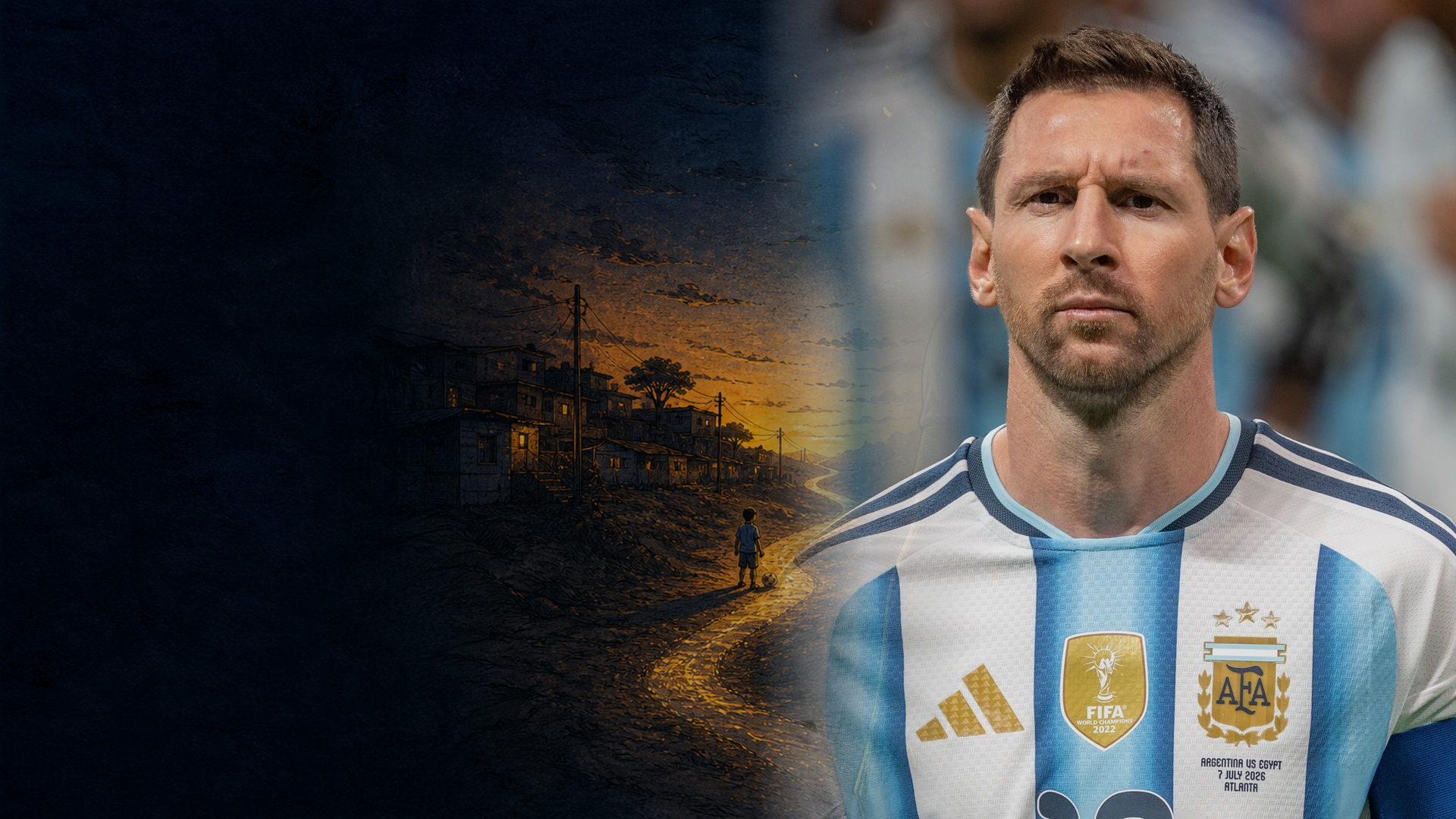
When Lionel Messi finally lifted the World Cup, the victory carried every place he had left and every final he had lost.
Stories · EP30
Stories: Lionel Messi — The Long Road Home
The departures, defeats, and return that changed Lionel Messi's relationship with Argentina
Free membership
Sign up free to unlock this episode.
After you log in, every lesson is 100% free — full audio, interactive transcript, expressions, and speaking practice. No paid plan.
- Unlimited access to the full episode library
- Synced transcripts and key expressions
- Save favorites and build your word list
Two newest episodes stay open for guests so you can try Atoz first.
Ready. Select a line to jump into the conversation.
It looked like the perfect ending, but perfection had very little to do with the road that brought him there.
His story was shaped by separation, doubt, public disappointment, and the decision to return after saying he was finished.
To understand that final night in Qatar, we have to begin in Rosario, Argentina.
Messi was born there in 1987 and grew up in a close family that treated football as part of everyday life.
He played for local teams as a young child and joined the youth system of Newell's Old Boys when he was six.
Even then, his balance, close control, and ability to move through crowded spaces made him unusual.
But while his skill developed quickly, his body was not growing at the expected rate.
Doctors identified a growth hormone deficiency, and the treatment placed a serious financial burden on his family.
Talent had opened a door, but walking through it would require the family to leave something behind.
At thirteen, Messi traveled to Barcelona for a trial that could change his future.
The club saw his potential, but the decision moved slowly while his family waited in uncertainty.
A famous early agreement was written on a paper napkin, a fragile object carrying an enormous promise.
Barcelona would bring him into its academy and help cover the medical treatment he needed.
For a teenager, however, opportunity did not erase homesickness.
Rosario was more than the place he had lived; it held his language, relatives, friends, and earliest sense of belonging.
Some members of his family returned to Argentina while Messi remained in Spain with his father.
He was quiet, physically small, and separated from much of the life that had made him feel secure.
The move is often told as the beginning of inevitable greatness, but at the time it was a gamble made by a child.
The first long road in Messi's life was not toward a trophy; it was away from home.
Inside Barcelona's academy, the qualities seen in Rosario became harder to ignore.
Messi did not dominate through size or loud authority.
He changed direction before defenders could adjust and kept the ball close enough to make crowded fields feel open.
He made his senior competitive debut for Barcelona in 2004, while still seventeen.
The teenager soon became part of a team that would redefine modern club football.
Goals, league titles, European trophies, and individual awards arrived in extraordinary numbers.
With Barcelona, his movement appeared natural and his place in the system seemed unquestioned.
Yet every club success made the contrast with his international career more visible.
In Spain, Messi was celebrated as the center of a historic team.
In Argentina, many people still waited for proof that he could deliver the country's greatest prize.
That demand carried the weight of another name: Diego Maradona.
Maradona had led Argentina to the 1986 World Cup and occupied a unique place in the country's imagination.
Messi was compared with him before Messi had time to define himself.
The comparison created a nearly impossible standard, because style, personality, and historical moment were all different.
Messi was criticized for being too quiet and for appearing more comfortable in Barcelona than with Argentina.
Questions about loyalty followed him even though he had chosen to represent the country of his birth.
He had left Argentina to survive as a young player, yet that departure was sometimes treated as emotional distance.
The tension made every international tournament feel like a public judgment on his identity.
A brilliant match could create hope, but a lost final could reopen the same accusation.
Success with the national team became more than a sporting goal; it became a search for acceptance at home.
Argentina came painfully close at the 2014 World Cup in Brazil.
Messi helped carry the team to the final, where Germany scored the only goal during extra time.
After the match, he received the Golden Ball as the tournament's best player.
But the individual honor could not soften the sight of the World Cup standing just beyond his reach.
One year later, Argentina lost the Copa América final to Chile in a penalty shootout.
In 2016, the same opponent defeated Argentina on penalties in another Copa América final.
Messi missed his kick in the shootout and watched a third major final disappear in three consecutive years.
The defeats were not identical, but together they created the feeling of a closed circle.
No matter how far Argentina traveled, the ending seemed to return Messi to the same place.
This time, he did not speak as if another attempt would automatically follow.
After the 2016 final, Messi announced that his time with the national team was over.
He said he had tried many times and that becoming a champion with Argentina was not happening for him.
The statement sounded final because it came from exhaustion rather than anger alone.
For years, he had carried the belief that every national defeat revealed a personal failure.
Leaving offered relief from a test that could never be fully satisfied.
But the announcement also revealed how deeply the national team mattered to him.
People across Argentina asked him to reconsider, and young supporters held signs asking him not to go.
Within weeks, Messi reversed his decision and returned.
Coming back did not guarantee a different ending, and it exposed him to the same criticism again.
That is what made the return important: he chose the unfinished relationship instead of protecting himself from it.
The next World Cup in 2018 brought another disappointment when France eliminated Argentina in the round of sixteen.
The team looked unstable, and Messi's international story again appeared to be running out of time.
Then a younger group began to form under coach Lionel Scaloni.
The new team respected Messi's history without asking him to carry every responsibility alone.
Their relationship with him felt less like dependence and more like shared purpose.
At the 2021 Copa América, Argentina reached another final against Brazil at the Maracanã.
Ángel Di María scored, Argentina defended the lead, and the match ended one to zero.
For the first time, Messi had won a major senior title with his national team.
His teammates ran toward him, lifted him, and turned an individual burden into a collective celebration.
The victory did not erase the lost finals, but it changed what those defeats meant.
Argentina arrived at the 2022 World Cup with confidence, unity, and a long unbeaten run.
Then Saudi Arabia defeated them in their opening match, producing one of the tournament's greatest surprises.
For an older version of the team, the shock might have reopened every old fear.
Instead, Messi told supporters to trust the group and promised that it would not abandon them.
Argentina recovered, and Messi contributed in every knockout round as the team advanced.
The final against France became a contest that seemed to change its ending several times.
Messi scored twice, Kylian Mbappé scored three times, and the match finished three to three after extra time.
Argentina won the penalty shootout four to two, thirty-six years after its previous World Cup title.
At thirty-five, Messi had finally reached the trophy that had followed him through nearly two decades of international football.
The moment felt complete because the road had repeatedly refused to be simple.
After the final, Messi said he wanted to keep playing for Argentina as a world champion.
The player who had once announced his departure now wanted more time in the shirt that had caused him so much pain.
That reversal gives the story its deepest meaning.
Home was never simply Rosario, Barcelona, or a stadium filled with supporters.
It was the place where talent, family, criticism, memory, and belonging remained connected.
Messi could not return to the childhood he had left at thirteen.
He could only return as the person formed by all the years away.
The World Cup did not prove that every painful journey ends in victory.
It showed that an unfinished story can remain open when someone is willing to come back to it.
That's all for today's episode.
Lionel Messi's long road home was completed not by avoiding defeat, but by returning after defeat had told him to leave.
Thanks for listening, and we'll see you next time.
Speaking practice
Speak It Out
Take a moment to answer each question in English.
Recording is off. Click a question to play it.
Why do you think returning to Argentina after his retirement announcement was an important part of Lionel Messi's story?
Click to play
Can a major victory change the meaning of earlier failures, or do those failures remain equally important? Explain your view.
Click to play