Imagine having enough money to buy almost anything.
Stories · EP43
Stories: What the World's 10 Richest People Want Next
The lifestyles, public choices, and ambitions behind the world's largest personal fortunes.
Free membership
Sign up free to unlock this episode.
After you log in, every lesson is 100% free — full audio, interactive transcript, expressions, and speaking practice. No paid plan.
- Unlimited access to the full episode library
- Synced transcripts and key expressions
- Save favorites and build your word list
Two newest episodes stay open for guests so you can try Atoz first.
Ready. Select a line to jump into the conversation.
What would you want next: a private island, a basketball team, a new kind of computer, or a city on Mars?
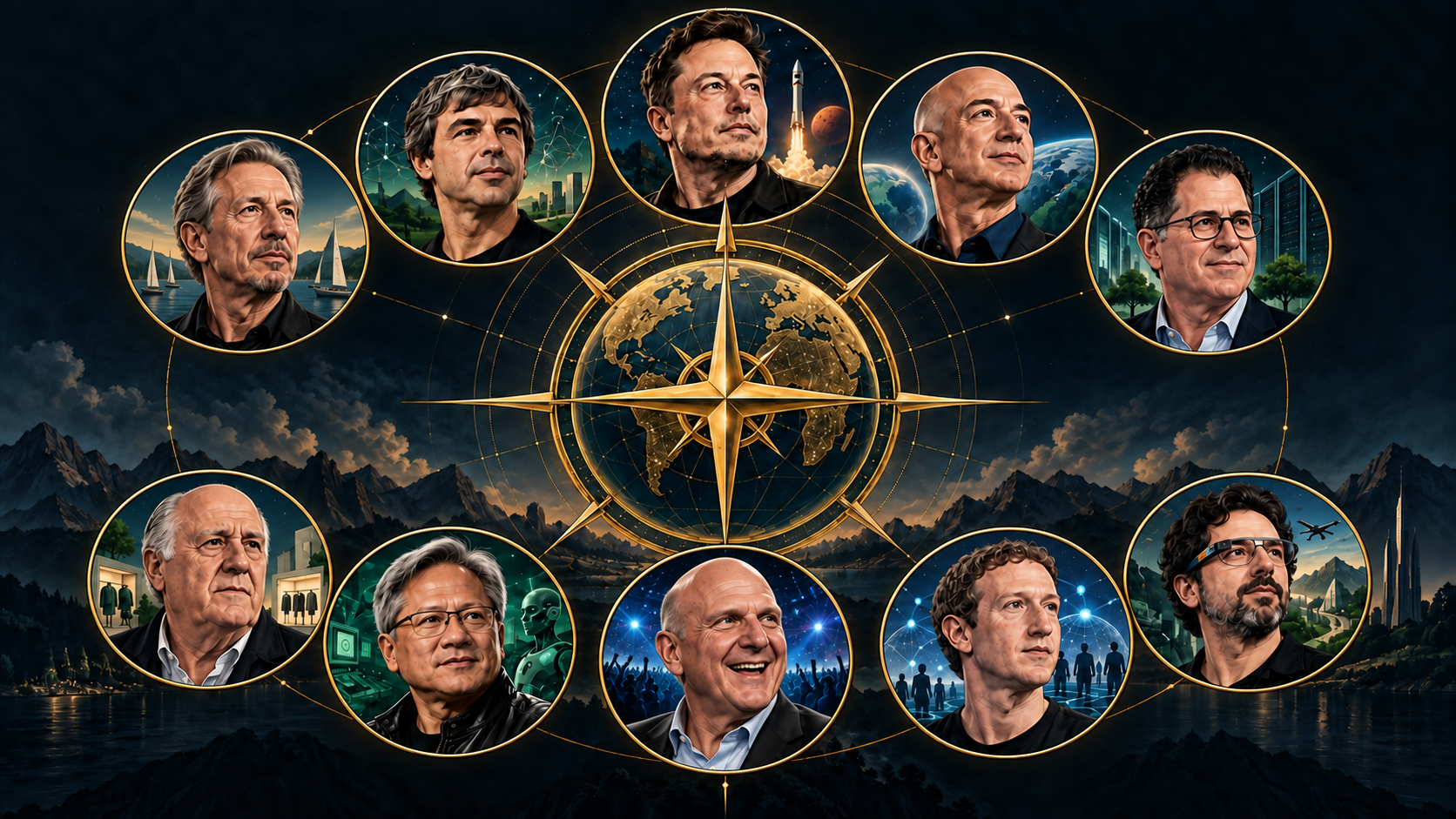
Today, we are looking at the ten richest people in the world and the lives they have chosen to build.
This is not simply a tour of expensive houses, cars, and private jets.
The more interesting question is what people pursue after money stops being an ordinary limit.
Forbes placed these ten people at the top when this episode was prepared in early September 2026.
The ranking is only a snapshot in time because stock prices can change it every day.
Their estimated wealth is also tied mainly to company shares, not mountains of cash in a bank.
Even with those limits, their public choices reveal strikingly different ideas about wealth.
At number one is Elon Musk.
Yet his public life appears to remain centered on companies, engineering problems, and urgent deadlines.
SpaceX describes its deepest mission as making human life multiplanetary.
Tesla and his AI businesses add other ambitions involving energy, transportation, robots, and intelligence.
For Musk, extreme wealth seems to buy speed and influence rather than an escape from work.
Number two is Larry Page, one of Google's two founders.
Page stepped back from daily management at Alphabet, but he kept voting power and a board position.
His lifestyle is defined less by visible luxury and more by an unusually low public profile.
Reports now connect him to another AI project focused on designing and manufacturing physical products.
Page represents the billionaire who chooses privacy while continuing to place distant technological bets.
Jeff Bezos holds the third position.
His lifestyle is more visible, including major travel, a large yacht, fitness, and high-profile social events.
However, his most important personal project may still be Blue Origin.
The company wants to build a road to space where millions of people could eventually live and work.
Bezos has also returned to an operating role through an AI venture connected to physical engineering.
At number four is Michael Dell.
Compared with several names on this list, Dell maintains a quieter public life centered on business and family philanthropy.
He and his wife recently committed billions of dollars to investment accounts for millions of American children.
His current work connects two goals: building AI infrastructure and giving more families a financial starting point.
Sergey Brin, Google's other cofounder, ranks fifth.
The rise of generative AI pulled him back into hands-on work, including technical contributions to Gemini.
He has also directed major donations toward research on nervous-system diseases and climate change.
Brin's public pattern combines privacy, technical curiosity, and a willingness to return when the problem feels important.
Number six is Mark Zuckerberg.
Meta is placing enormous bets on artificial intelligence, smart glasses, virtual worlds, and new computing platforms.
Outside Meta, the Chan Zuckerberg Initiative is concentrating on AI-powered biology and disease research.
Zuckerberg is using capital to redesign both digital environments and some of the tools used to study human biology.
Larry Ellison is seventh.
He owns most of the Hawaiian island of Lanai, one of the clearest symbols of private wealth on this list.
Oracle is competing in AI cloud infrastructure, while Ellison and his family have pursued major media investments.
His choices show a strong attraction to scale, ownership, and control over complex systems.
At number eight is Nvidia chief executive Jensen Huang.
Huang spends much of his time meeting engineers, customers, governments, and technology partners around the world.
Nvidia's larger ambition is to make AI a new industrial foundation for science, robotics, and physical machines.
Huang's wealth looks less like a destination than a result of one long-term bet that is still unfolding.
Steve Ballmer is number nine.
The former Microsoft chief is now best known as the energetic owner and loudest fan of the Los Angeles Clippers.
Ballmer has also supported public-data projects that help people understand government spending and social outcomes.
His intensity moved from software to sports, civic information, and the shared energy of a crowd.
Number ten is Amancio Ortega, the founder and controlling shareholder of Inditex, the company behind Zara.
He rarely gives interviews and has remained closely connected to his home region in northwestern Spain.
Ortega receives large dividends and reinvests much of that money in offices, homes, and logistics properties.
His pattern favors quiet ownership and durability over turning himself into a global personal brand.
Now step back from the ten individual stories.
Nine of these fortunes are rooted in technology, while Ortega's began in fashion retail.
That is why one market move can add or remove billions of dollars from a person's estimated net worth.
Many people on this list choose projects with horizons measured in decades, from space settlements to disease research.
The second pattern is a desire for control over platforms, infrastructure, media, land, or public experiences.
Their money allows personal preferences to become systems that millions of other people may eventually use.
Visible luxury does not tell us whether a person's companies create public value or public harm.
A simple public image does not automatically prove generosity, wisdom, or fairness either.
To judge lasting influence, we must examine labor, privacy, competition, the environment, philanthropy, and political power.
Wealth makes choices larger, but it does not make those choices automatically good.
If money were no longer a limit, what would your calendar reveal about what you truly value?
The world's richest people give very different answers, but few of them choose to stop building.
That's all for today's episode.
Great wealth can buy comfort, but its deeper power is the ability to turn one person's priorities into reality.
Thanks for listening, and we'll see you next time.
Speaking practice
Speak It Out
Think about what money reveals about priorities, responsibility, and influence.
Recording is off. Click a question to play it.
If money were no longer a limit, what long-term goal would you choose, and why?
Click to play
Which reveals a person's values more clearly: spending, work, or philanthropy? Explain your answer.
Click to play