Nvidia has delivered another quarter that looks almost unreal.
Big Tech & AI · EP37
Nvidia Earnings: Is the AI Boom Still Accelerating?
Record data center sales reveal how chips, networking, software, and inference are reshaping the AI economy.
Free membership
Sign up free to unlock this episode.
After you log in, every lesson is 100% free — full audio, interactive transcript, expressions, and speaking practice. No paid plan.
- Unlimited access to the full episode library
- Synced transcripts and key expressions
- Save favorites and build your word list
Two newest episodes stay open for guests so you can try Atoz first.
Ready. Select a line to jump into the conversation.
Revenue reached ninety-six point two billion dollars in only three months.
That was more than double the figure from the same period one year earlier.
Data center revenue alone reached eighty-nine billion dollars.
So is the AI boom still accelerating, or are these numbers hiding a future slowdown?
To answer that question, we need to understand what Nvidia is actually selling.
Many people still think of Nvidia as a company that makes graphics cards.
That description was once useful, but it is now far too small.
Nvidia increasingly sells complete computing systems for building and running artificial intelligence.
The chip is only the most visible piece of that system.
An advanced AI model needs thousands of processors to work together.
Those processors must exchange data at enormous speed without wasting time or electricity.
Nvidia therefore sells graphics processors, networking equipment, server designs, and the software that connects everything.
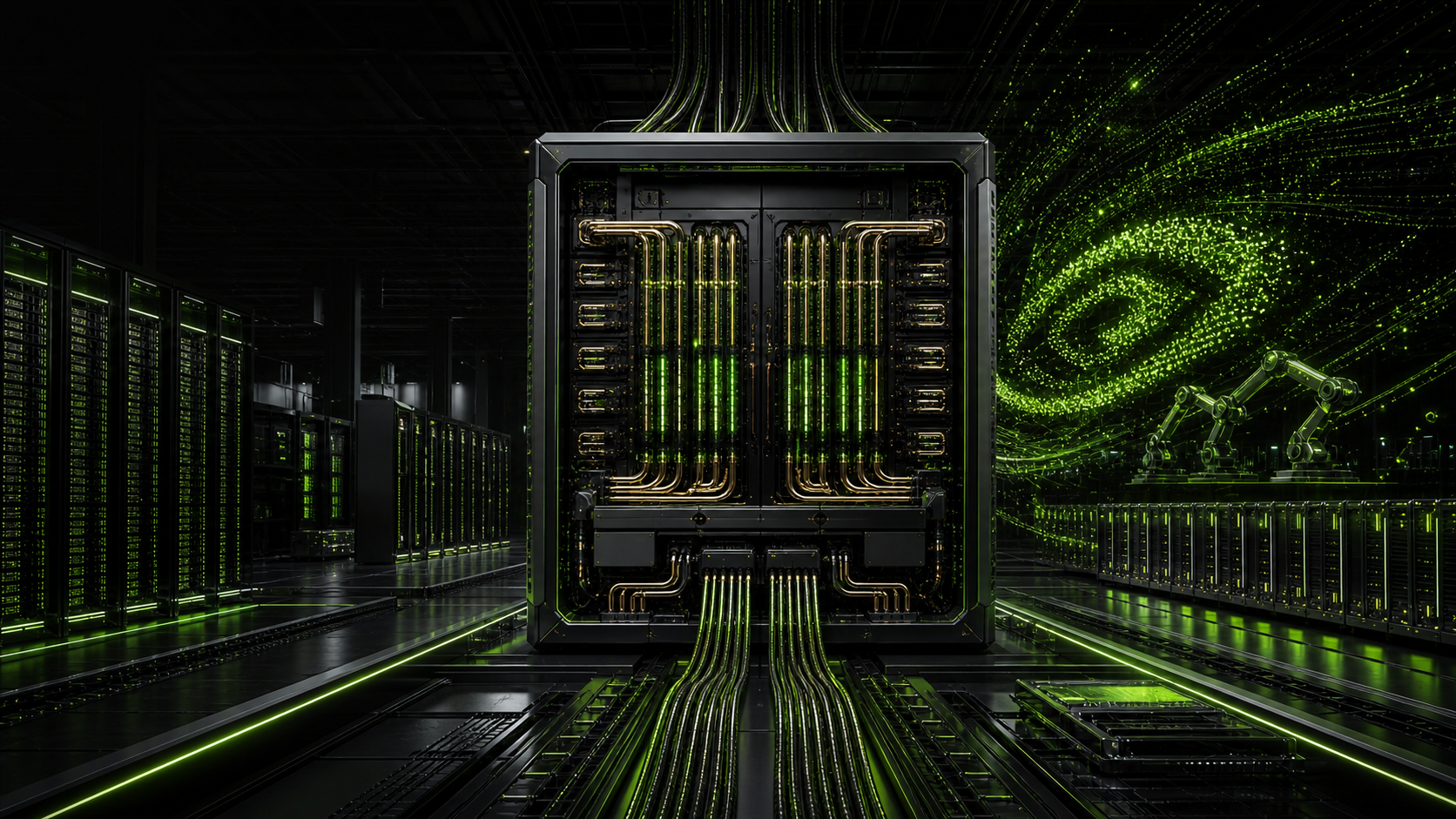
Think of a modern AI data center as a factory.
Electricity and data enter the building, while useful AI responses come out.
Nvidia provides much of the machinery, the internal roads, and the operating instructions for that factory.
This explains why the company often uses the term AI factory.
It also explains why one customer order can be worth billions of dollars.
The first reason for Nvidia's growth is that AI models require more computing power as they become more capable.
Training a frontier model is extremely expensive, but training is only the beginning.
Every time a user asks an AI assistant a question, computers must perform inference.
Inference means using a trained model to produce a new answer, image, prediction, or action.
When millions of people and businesses use AI every day, inference demand can become larger than training demand.
New reasoning models make this effect even stronger.
They may spend more time and computing power before producing one answer.
Better AI can therefore reduce the cost of each calculation while increasing the total number of calculations.
Economists sometimes call this the rebound effect.
When a useful technology becomes cheaper, people often use much more of it.
The second growth engine is a change in who is buying.
Early AI demand was concentrated among a small number of major cloud companies and leading research labs.
Now governments, startups, manufacturers, drug companies, banks, and robotics developers are also building AI infrastructure.
Not every organization will own a giant data center.
Many will rent Nvidia-powered computing through cloud services.
Either way, someone must purchase and operate the underlying equipment.
The latest results suggest that this customer base is still expanding.
Nvidia said its data center revenue rose one hundred seventeen percent from a year earlier.
It also expects total revenue of about one hundred eight billion dollars next quarter.
That forecast does not assume any data center computing revenue from China.
The third engine is Nvidia's competitive moat.
A moat is an advantage that makes it difficult for competitors to take customers away.
Nvidia's moat begins with high-performance chips, but it does not end there.
For almost two decades, developers have used its CUDA software platform to program graphics processors.
Universities taught it, researchers built tools around it, and companies trained engineers to use it.
This created an ecosystem of software, skills, and technical support.
A competing chip may be cheaper, but changing platforms can create new engineering costs and delays.
Large customers also care about reliability at the scale of an entire data center.
Thousands of expensive processors are useful only if they can communicate efficiently.
Nvidia's networking technology and rack-scale designs help solve that problem.
The company is moving from selling individual chips to delivering an integrated platform.
That strategy gives customers a faster path to working AI capacity.
It also allows Nvidia to capture more revenue from each project.
The newest Vera Rubin platform shows this system-level approach.
It combines new processors, networking, cooling, and software into coordinated racks.
Nvidia says the platform is entering full production with major cloud partners.
Strong financial results do not mean the future is risk-free.
The first major question is whether customers can earn enough money from their AI spending.
Cloud companies are investing enormous sums in data centers, power, and specialized equipment.
Eventually, their AI products must produce revenue or meaningful cost savings.
If that return on investment disappoints, customers could slow future orders.
This is the difference between infrastructure demand and sustainable end-user demand.
Nvidia currently benefits when companies build capacity.
The next test is whether businesses and consumers use that capacity profitably.
The second risk is customer concentration.
A relatively small group of cloud companies can influence a large share of AI infrastructure spending.
They are Nvidia customers, but they are also designing their own AI chips.
Google, Amazon, Microsoft, and other large buyers want lower costs and more control.
Custom chips may not replace Nvidia across every workload.
However, they could take part of the inference market where efficiency matters more than maximum flexibility.
AMD and specialized chip startups create additional competitive pressure.
The third risk is physical rather than digital.
AI data centers need power, cooling systems, land, transformers, and access to the electrical grid.
A chip can be designed faster than a new power plant or transmission line can be built.
That means electricity and construction delays may limit how quickly customers can install new systems.
Supply constraints have moved beyond semiconductors into the wider energy and industrial economy.
Geopolitics creates another uncertainty.
Advanced chip exports to China remain restricted, and the rules can change.
Nvidia excluded China data center compute revenue from its next-quarter forecast.
That makes the forecast more conservative, but it also shows that a major market is not fully accessible.
There is also a financial signal hidden inside the headline numbers.
Nvidia reported a gross margin of seventy-five percent.
Gross margin measures how much revenue remains after the direct cost of producing what was sold.
A seventy-five percent margin is unusually high for a hardware-heavy business.
It suggests that customers are paying for scarce performance and a complete ecosystem, not only for silicon.
But high margins invite competition and customer efforts to reduce dependence.
So what does this quarter tell us about the AI boom?
It tells us that infrastructure demand is still accelerating today.
The expansion has moved beyond model training toward inference, reasoning, robotics, and national AI systems.
Nvidia remains difficult to challenge because it combines chips, networking, systems, and software.
But the next phase will be judged by more than chip sales.
Investors should watch whether AI services generate revenue, whether power supply keeps up, and whether custom chips gain market share.
They should also watch whether Nvidia can maintain its margins as competition grows.
The most important lesson is that Nvidia is no longer simply selling components.
It is selling the production system behind the AI economy.
That is why its revenue can grow so quickly when the entire industry builds at once.
It is also why any slowdown in that building cycle would matter far beyond one company.
That's all for today's episode.
The AI boom is still accelerating, but its long-term strength depends on useful and profitable AI demand.
Thanks for listening, and we'll see you next time.
Speaking practice
Speak It Out
Think about what could sustain or slow the AI infrastructure boom.
Recording is off. Click a question to play it.
Which part of Nvidia's competitive moat seems hardest for another company to copy, and why?
Click to play
What evidence would convince you that today's AI infrastructure spending is sustainable?
Click to play