If SpaceX and Tesla combine, SpaceX may be the buyer.
Big Tech & AI · EP34
Could SpaceX Buy Tesla?
Why the market's leading merger scenario puts SpaceX in the buyer's seat—and what it could mean for both groups of shareholders.
Free membership
Sign up free to unlock this episode.
After you log in, every lesson is 100% free — full audio, interactive transcript, expressions, and speaking practice. No paid plan.
- Unlimited access to the full episode library
- Synced transcripts and key expressions
- Save favorites and build your word list
Two newest episodes stay open for guests so you can try Atoz first.
Ready. Select a line to jump into the conversation.
That structure follows from the relative size, ownership, and public-market position of the two companies.
No transaction has been announced, and neither board has published formal terms.
This episode examines the all-stock scenario now receiving serious market attention.
In that scenario, SpaceX would issue new shares to Tesla shareholders and bring Tesla inside the larger SpaceX group.
So why does the SpaceX-buyer structure attract attention?
The answer begins with SpaceX's position in Elon Musk's business network.
SpaceX acquired xAI in February 2026, placing rockets, Starlink, X, and Grok under one corporate roof.
Tesla then completed a two-billion-dollar investment in SpaceX shares in March.
After SpaceX entered public markets, its stock became a possible currency for another very large transaction.
That does not mean a Tesla acquisition is planned.
It does explain why investors ask whether SpaceX could use its shares to buy Tesla.
An all-stock acquisition does not require SpaceX to pay the full price in cash.
Instead, Tesla shareholders would exchange their Tesla shares for newly issued SpaceX shares.
The exchange ratio would determine how much of the combined company each group owns.
This is where market value becomes important.
In mid-July, Fortune estimated SpaceX at about 2.8 trillion dollars and Tesla at about 1.6 trillion.
At those values, SpaceX could theoretically buy Tesla by issuing shares equal to roughly 57 percent of its existing share count.
But the calculation changed quickly when SpaceX shares fell.
By July 24, Fortune estimated SpaceX at about 1.49 trillion dollars and Tesla at about 1.22 trillion.
SpaceX would then need to issue shares equal to roughly 82 percent of its existing count.
Those figures were snapshots, not a proposed deal price.
They show why the buyer's stock price can decide whether an all-stock acquisition looks possible or painful.
For existing SpaceX owners, the central risk would be dilution.
They would own a smaller percentage of SpaceX after the company issued shares to Tesla investors.
The question is not simply whether the combined company becomes larger.
The question is whether each SpaceX share gains enough earning power to justify giving away that ownership.
Tesla shareholders would face a different calculation.
They would surrender a direct investment in Tesla and receive shares in a much broader company.
That company would include launch services, Starlink, xAI, X, and possibly Tesla's vehicles, energy systems, autonomy, and robots.
Some Tesla investors may welcome access to that larger platform.
Others may not want their auto and energy investment mixed with capital-heavy space and AI projects.
The control premium would be one of the hardest issues.
A buyer normally offers more than the unaffected market price to persuade shareholders to give up control.
But a very high Tesla premium would require SpaceX to issue even more shares.
That would transfer more value from existing SpaceX owners to Tesla owners.
A low premium might protect SpaceX shareholders but fail to win Tesla shareholder approval.
The exchange ratio must therefore balance two volatile market values and two very different groups of investors.
There is also a strategic case for the acquisition.
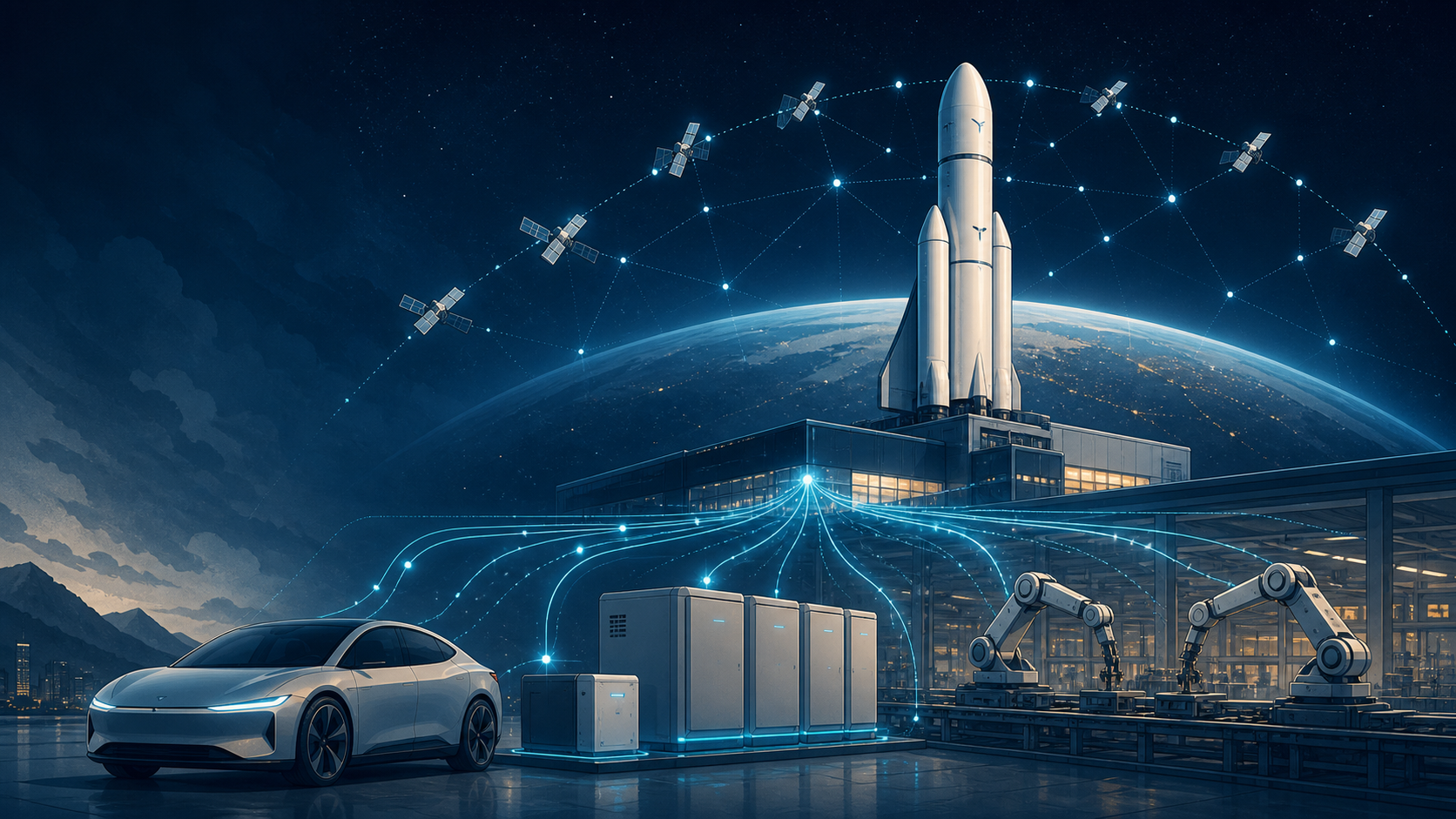
Tesla manufactures vehicles, batteries, power electronics, energy storage systems, AI computers, and robots.
SpaceX operates launch systems, satellites, communications networks, and the xAI computing platform.
Starlink could connect Tesla vehicles and robots in places where ordinary networks are weak.
Tesla batteries and Megapacks could support SpaceX and xAI infrastructure.
The companies are also collaborating on advanced manufacturing and computing projects.
Supporters see a vertically integrated system connecting energy, machines, communications, AI, and space.
They believe one balance sheet could move money and talent toward the highest-return project.
Yet most of those benefits do not require an acquisition.
Starlink services can be sold through a commercial agreement.
Megapacks can be purchased through supply contracts.
Engineers can collaborate through joint ventures with defined budgets and responsibilities.
If contracts capture most of the benefit, issuing enormous amounts of SpaceX stock may be unnecessary.
This makes the stand-alone question essential.
What can SpaceX and Tesla achieve while remaining separate companies?
A merger should create benefits that ordinary contracts cannot deliver nearly as well.
Governance may be even more difficult than strategy.
Elon Musk has influence on both sides of the possible transaction.
He also has much stronger voting control at SpaceX than at Tesla.
If Tesla moves under SpaceX, Tesla shareholders could exchange their current voting rights for a company where Musk's control is more concentrated.
That does not automatically make the structure unfair.
It makes independent review and clear disclosure especially important.
Musk should not negotiate the exchange ratio for both sides.
Each company would need an independent special committee with separate legal and financial advisers.
Both groups of shareholders should see valuation ranges, dilution tables, and realistic stand-alone plans.
The boards would also need to explain how Tesla's performance awards change after an acquisition.
Investors should know whether a transaction changes the operational milestones attached to Musk's compensation.
There is another major obstacle: Tesla's exposure to China.
SpaceX is a United States defense contractor handling sensitive launch and communications infrastructure.
Tesla operates major manufacturing and commercial activities in China.
Putting Tesla under SpaceX could raise questions about national security, export controls, data, and government contracts.
Reports about a possible separation of Tesla's China business intensified that discussion.
Musk publicly rejected the reported separation story.
For investors, the disagreement is a reminder to separate formal filings from speculation.
A transaction this large would also face reviews in many countries.
No valuation model should assume fast approval or ignore the cost of restructuring Tesla's global operations.
Execution risk would remain after any closing.
Tesla still needs to compete in vehicles, improve service, protect margins, scale storage, and prove autonomy safely.
SpaceX must maintain launch reliability, replace satellites, expand Starlink, manage xAI, and fund ambitious infrastructure.
One company could coordinate those goals more easily.
It could also become too large and complex for investors or managers to evaluate clearly.
So what should the market watch?
First, look for board filings or a formally appointed special committee.
Second, watch the relative market values of SpaceX and Tesla because they drive the exchange ratio.
Third, examine whether any offer includes a control premium for Tesla shareholders.
Fourth, measure the dilution imposed on existing SpaceX owners.
Fifth, look for evidence that the expected synergies cannot be achieved through contracts.
Finally, watch how any proposal handles voting control, Musk's compensation, and Tesla's China operations.
The market's current scenario is more specific than a vague merger headline.
It imagines SpaceX using its shares to acquire Tesla and place another Musk company under the SpaceX umbrella.
That structure may look logical because SpaceX already absorbed xAI and now has publicly traded stock.
But logical structure is not the same as fair economics.
The transaction would need a defensible Tesla price, manageable SpaceX dilution, independent governance, and benefits that exceed the risks.
Until formal terms appear, this remains a scenario rather than a deal.
That's all for today's episode.
The key question is whether this structure creates fair value for both groups of shareholders.
Thanks for listening, and we'll see you next time.
Speaking practice
Speak It Out
Recording is off. Click a question to play it.
If SpaceX offered to buy Tesla with stock, which group of shareholders would face the greater risk, and why?
Click to play
Which benefit would be strong enough to justify a SpaceX and Tesla combination instead of a commercial partnership?
Click to play
Key Expressions
the math changesthe financial result becomes different when an important assumption changes
analytical
- comparing merger structures
- revising a valuation
When the buyer's share price falls, the merger math changes.