Your car changes lanes, turns at busy intersections, and follows a route across town.
Big Tech & AI · EP33
Tesla FSD: Why the Last 1% Is So Hard
Tesla's self-driving software can look remarkably capable, but the rare moments it gets wrong are the hardest to solve.
Free membership
Sign up free to unlock this episode.
After you log in, every lesson is 100% free — full audio, interactive transcript, expressions, and speaking practice. No paid plan.
- Unlimited access to the full episode library
- Synced transcripts and key expressions
- Save favorites and build your word list
Two newest episodes stay open for guests so you can try Atoz first.
Ready. Select a line to jump into the conversation.
For a few minutes, Tesla's Full Self-Driving can make the future feel very close.
So why can you not read a book, take a nap, or stop watching the road?
The answer is hidden in the last one percent of driving.
That last one percent is rare, messy, and sometimes dangerous.
It is also the part that decides whether a system is helpful or truly autonomous.
Tesla began its driver-assistance journey with Autopilot more than a decade ago.
At first, the most familiar features were lane keeping and traffic-aware cruise control.
Over time, Tesla added navigation, automatic lane changes, parking features, and city-street driving.
The name Full Self-Driving sounds complete, but the current product is called FSD Supervised.
Tesla says the driver must remain attentive and ready to take control at all times.
That distinction is not a small legal detail.
It describes who is responsible when the unexpected happens.
To understand the challenge, imagine a normal drive to a coffee shop.
Most of the route is made of familiar patterns.
The road is clear, the traffic lights work, and other cars mostly follow the rules.
Modern AI is increasingly good at recognizing those patterns and choosing a smooth path.
That is why FSD can look surprisingly human on a successful drive.
Tesla's basic idea is simple to describe, even if the engineering is not.
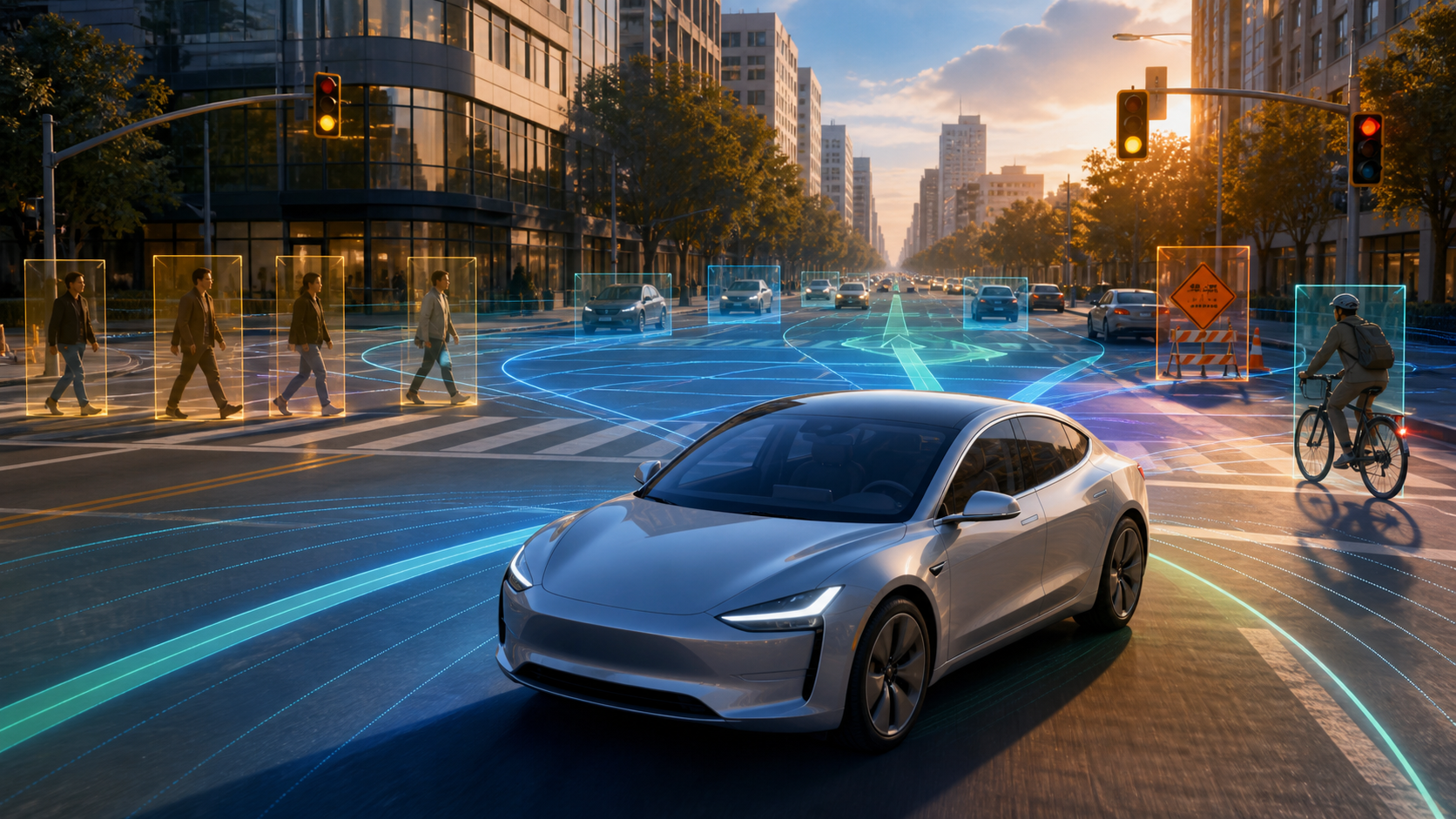
Cameras around the car collect video from many directions.
Neural networks turn those images into a live picture of lanes, vehicles, people, signs, and open space.
The car then predicts what may happen next and plans a path through that scene.
Tesla builds specialized chips to run those models inside the vehicle.
Software updates can improve the system without changing the physical car.
This is a powerful advantage because improvements can reach a large fleet quickly.
Tesla also learns from difficult clips collected from real-world driving.
That loop of cars, data, training, and updates is often called a data flywheel.
In recent versions, Tesla has moved further toward end-to-end neural networks.
Instead of writing a separate rule for every possible turn, engineers train models from examples of driving.
That can make the car's behavior smoother and more flexible in ordinary situations.
But ordinary situations are not the real finish line.
The hard cases are called edge cases because they sit at the edge of what the system has seen.
A police officer may wave cars through a red light during an emergency.
A construction worker may point drivers into a temporary lane with faded markings.
A child may run after a ball from behind a parked van.
Heavy rain can hide lane paint just as sunlight can wash out a camera image.
Each example sounds manageable on its own.
The problem is that real streets create endless combinations of them.
This is sometimes called the long tail of driving.
The common cases appear again and again, while rare cases appear only once in a very long time.
Humans use broad experience, social signals, and common sense to fill in the gaps.
An AI system must make a safe choice without being certain that it understands the situation.
That uncertainty creates a difficult handover problem.
If the system needs help only on rare occasions, the person may be least prepared when help is needed.
A car that performs well for an hour can create a false sense of security.
That is why active supervision matters even when the drive looks easy.
Tesla's strategy is very different from the strategy used by Waymo.
Tesla wants a camera-based system that can improve across many roads and many customer cars.
Waymo operates driverless robotaxis within defined service areas and uses a richer sensor set.
Its approach is narrower at first, but it can focus intensely on specific cities and routes.
Tesla is trying to solve a broader problem at a lower hardware cost.
Waymo is trying to prove fully driverless service in a more controlled operational design domain.
Neither path makes the other meaningless.
They are answering different versions of the same question.
Can autonomy become useful everywhere, or must it first become extremely reliable somewhere?
Tesla's competitive strength may be scale.
Millions of connected vehicles can produce diverse driving data and receive updates over the air.
Its weakness is that broad public roads are also the least controlled environment imaginable.
A system must be not only impressive, but predictable enough for drivers, regulators, and insurers to trust.
Safety is difficult to measure because a short successful drive proves very little.
The serious question is how the system performs across huge numbers of difficult situations.
It also matters how clearly a company explains the system's limits to its users.
The future of FSD will probably arrive in steps, not in one dramatic overnight switch.
Cars may become more capable on highways, in parking lots, and on familiar urban routes.
Robotaxi services may expand city by city where companies can prove reliable performance.
But the final move from supervised help to full responsibility is much larger than a software update.
It means the machine must handle the rare moment when no attentive human is ready to rescue it.
Tesla FSD is not interesting because it has already solved self-driving.
It is interesting because it shows how far AI can go before the last one percent stops it.
That's all for today's episode.
The future of driving may be closer than it looks, but trust will depend on the moments no one can predict.
Thanks for listening, and we'll see you next time.
Speaking practice
Speak It Out
Reflect on what makes automated driving trustworthy.
Recording is off. Click a question to play it.
Which rare driving situation would make you least comfortable using an automated driving system, and why?
Click to play
Would you prefer a self-driving service that works only in a few cities or one that works almost everywhere with supervision? Explain your choice.
Click to play