When most people hear the name SpaceX, they picture a rocket rising from a launchpad.
Big Tech & AI · EP26
SpaceX's Vision
How Starship, Starlink, and space-based AI fit into one increasingly ambitious plan
Free membership
Sign up free to unlock this episode.
After you log in, every lesson is 100% free — full audio, interactive transcript, expressions, and speaking practice. No paid plan.
- Unlimited access to the full episode library
- Synced transcripts and key expressions
- Save favorites and build your word list
Two newest episodes stay open for guests so you can try Atoz first.
Ready. Select a line to jump into the conversation.
But in a recent address to employees, Elon Musk described a company that is trying to become something much larger.
The rockets still matter, but they are increasingly presented as the first layer of a much bigger system.
That system connects transportation, global communications, artificial intelligence, industry on the Moon, and eventually life on Mars.
At first, those ideas may sound like a list of unrelated science-fiction projects.
SpaceX's vision is easier to understand when we see how each part is supposed to support the next.
The starting point is access to orbit.
SpaceX built its current position by making rockets reusable and launching them frequently.
Falcon 9 proved that a booster could return, land, and fly again as part of a regular commercial operation.
Starship is meant to take that approach much further.
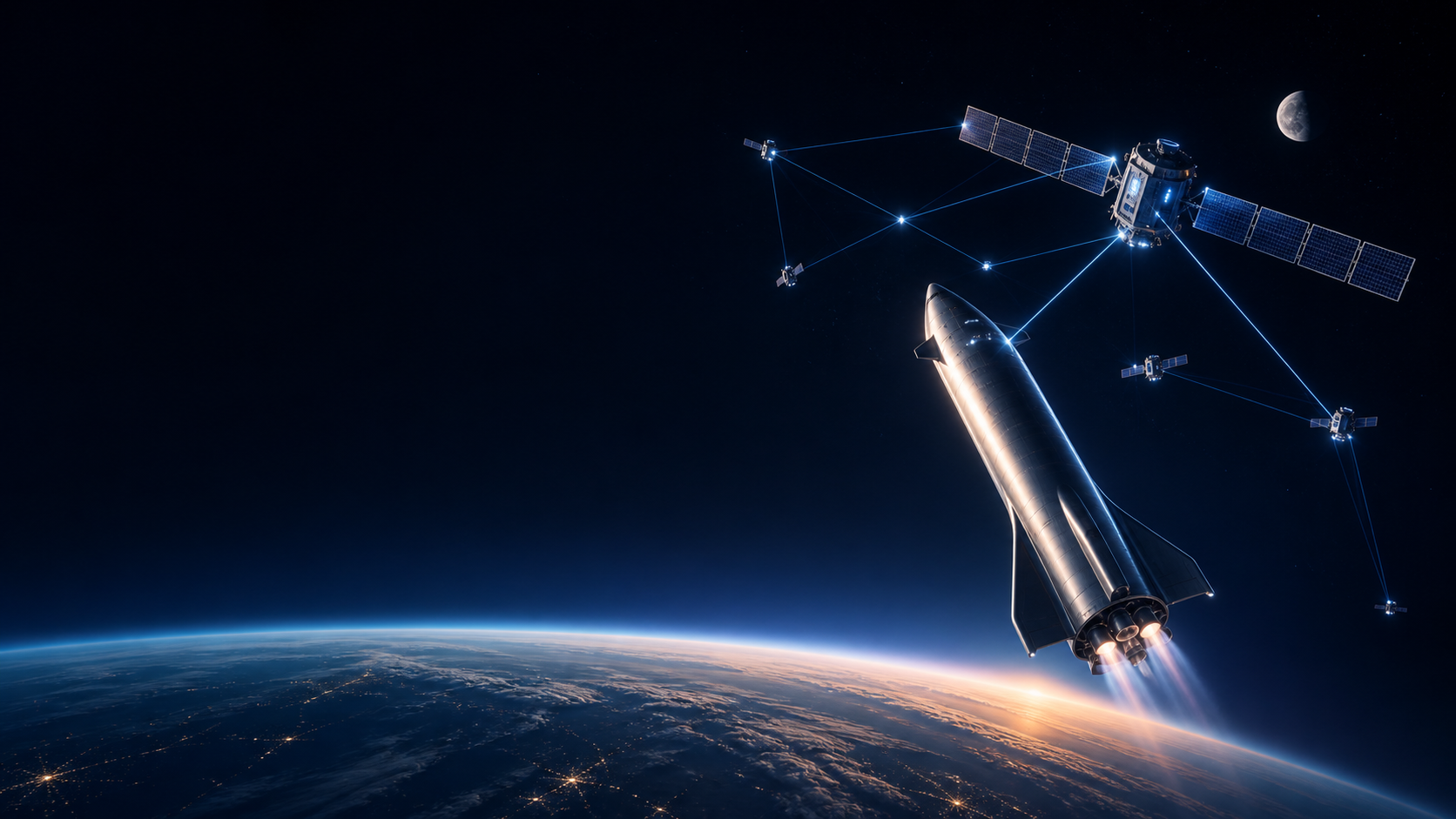
It is designed as a fully reusable transportation system capable of carrying far more mass into orbit.
If it becomes reliable, a larger vehicle with a lower cost per flight could change what is practical to build in space.
A satellite would no longer need to be designed around every kilogram with quite the same intensity.
Companies could launch larger equipment, replace it more often, and experiment on a scale that is difficult today.
This is why Starship is not simply another product in the plan.
It is the transportation layer on which almost everything else depends.
The second layer is Starlink.
Thousands of satellites already provide internet service to customers who may be far from reliable ground networks.
That makes Starlink a working business, not merely a distant promise.
It also gives SpaceX experience in manufacturing satellites, operating a large constellation, and managing communications across orbit.
The launch business supports Starlink, and Starlink can generate recurring revenue that supports new launch systems.
This creates a reinforcing loop inside one company.
Now SpaceX wants to add a third layer: artificial intelligence.
During the employee update, Musk argued that AI could become the most valuable part of SpaceX's future.
One near-term part of that strategy involves AI computing on Earth.
But the more unusual idea is Starmind, a proposed network of satellites designed to perform AI computation in orbit.
The basic argument begins with energy.
AI data centers need enormous amounts of electricity, cooling, land, and electrical infrastructure.
In orbit, a satellite can collect solar energy without clouds or nighttime during much of its path.
SpaceX proposes using large solar arrays to power computing payloads, then moving information through high-bandwidth laser links.
The output could then travel through the broader satellite network to users on Earth.
On a presentation slide, the logic looks elegant: abundant sunlight, global coverage, and no need to secure another huge piece of land.
In engineering terms, however, space-based computing is extremely demanding.
Heat does not disappear automatically in space, so powerful computers need large and carefully designed radiators.
Electronic equipment must survive radiation, launch vibration, and years without ordinary maintenance.
A damaged server on Earth can be repaired by a technician.
A damaged computer in orbit may simply become an expensive piece of debris.
The economics also depend on Starship achieving the launch cost and flight rate that SpaceX expects.
This shows how tightly the pieces are connected.
Without cheap and frequent launches, a giant orbital computing network is much harder to justify.
Without a large satellite network, moving data to and from those computers is also harder.
SpaceX is not proposing isolated products; it is proposing a vertically integrated stack.
One organization would build the rockets, manufacture the satellites, operate the network, and sell the computing service.
The employee address then extended this logic beyond Earth orbit.
Musk discussed the possibility of robotic factories on the Moon that could eventually manufacture space infrastructure away from Earth.
The Moon has materials, sunlight, and much weaker gravity than Earth.
In theory, equipment made there could be sent into space with less energy than equipment launched from Earth's surface.
That idea sits much farther out on the timeline.
A lunar factory would require mining, power generation, autonomous construction, manufacturing, and transportation systems that do not yet exist at commercial scale.
It is best understood as a destination for the strategy, not a near-term forecast.
Mars remains the final horizon in the SpaceX story.
The original mission of making humanity multiplanetary has not disappeared.
What has changed is the proposed economic path for getting there.
Launch revenue, global connectivity, and AI services could finance increasingly capable space infrastructure.
That infrastructure could then support activity on the Moon and, eventually, transportation to Mars.
It is a compelling flywheel, but every stage contains execution risk.
Starship must become operationally reliable.
Satellite networks must address regulation, orbital congestion, and debris.
Orbital computing must prove that its energy advantage is greater than its launch, cooling, maintenance, and replacement costs.
And lunar industry must move from diagrams to machines that can work for long periods with limited human support.
The useful way to evaluate SpaceX's vision is therefore not to label it either inevitable or impossible.
Instead, watch the dependencies.
Which part already works, which part is being tested, and which part still depends on several breakthroughs happening in sequence?
Today, reusable launch and satellite internet are real businesses.
Fully reusable heavy transport is still being developed.
Large-scale AI computing in orbit, lunar factories, and permanent settlements remain far more ambitious steps.
Seen together, however, they reveal the central idea behind SpaceX's vision.
Build a cheaper road to space, use that road to create valuable infrastructure, and let that infrastructure finance the next road farther outward.
The rocket is no longer the whole story.
It is the first link in a much longer chain.
That's all for today's episode.
Thanks for listening, and we'll see you next time.
Speaking practice
Speak It Out
Click a question to practice speaking after the episode. Turn on recording if you want to review your answer.
Recording is off. Click a question to play it.
Which part of SpaceX's vision seems most realistic to you, and which part seems most difficult? Explain the reasons for your choices.
Click to play
Do you think the benefits of putting AI computing in orbit could outweigh the costs and risks? What evidence would change your opinion?
Click to play