For years, Tesla's Fremont factory was known for building some of the company's most recognizable electric cars.
Big Tech & AI · EP25
Big Tech & AI: Tesla's Bet on Optimus
Why Tesla is turning car-factory space into a humanoid-robot bet—and what Optimus still has to prove
Free membership
Sign up free to unlock this episode.
After you log in, every lesson is 100% free — full audio, interactive transcript, expressions, and speaking practice. No paid plan.
- Unlimited access to the full episode library
- Synced transcripts and key expressions
- Save favorites and build your word list
Two newest episodes stay open for guests so you can try Atoz first.
Ready. Select a line to jump into the conversation.
Now part of that story is changing.
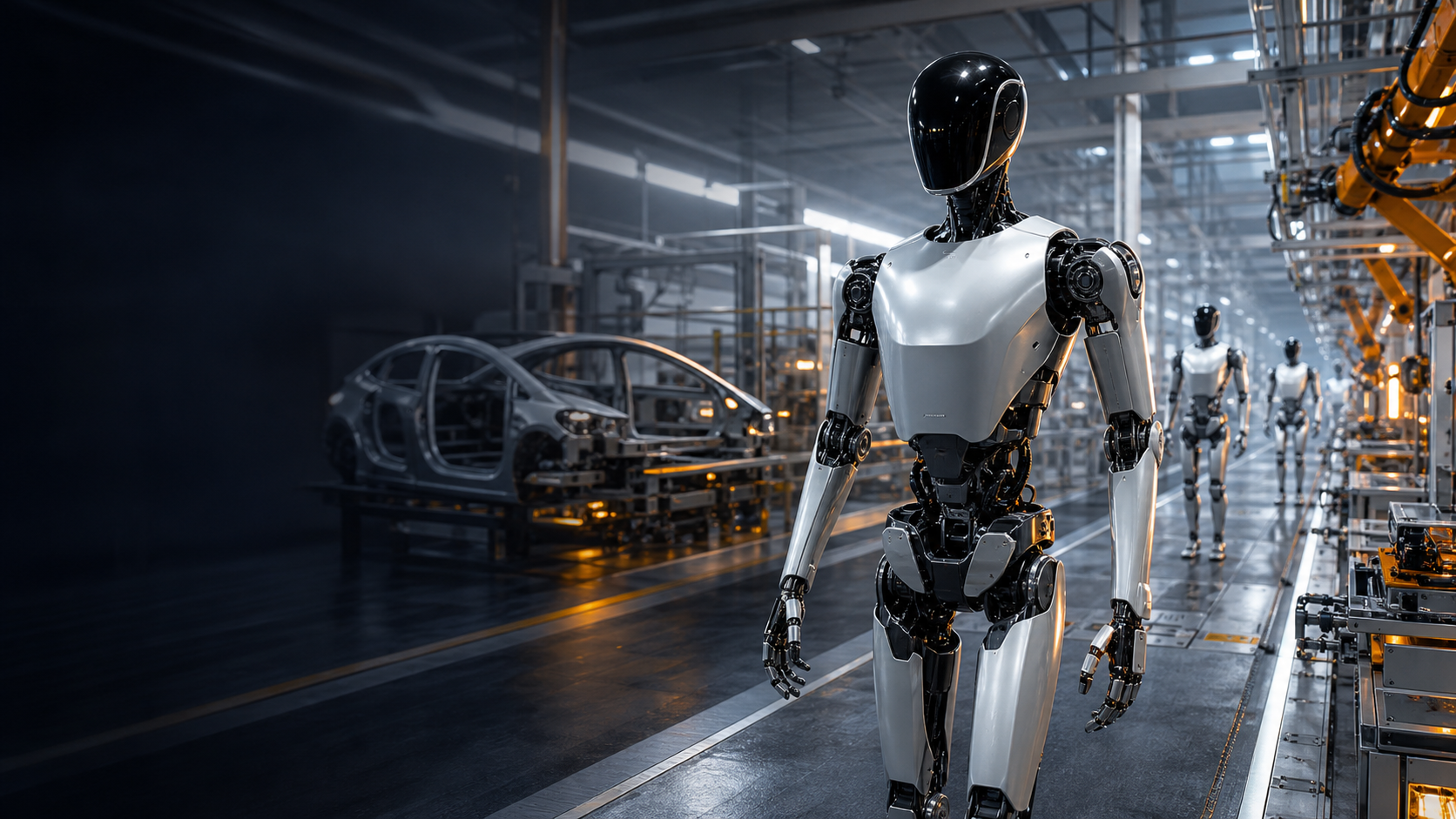
Tesla has ended production of the Model S and Model X and is converting factory space for Optimus, its humanoid robot.
That is more than a product update.
It signals a larger bet on what Tesla wants to become.
The company still makes cars, batteries, and energy products, but it increasingly describes its future through artificial intelligence, autonomy, and robotics.
Optimus is the physical version of that ambition.
Tesla describes it as a general-purpose, two-legged autonomous robot for tasks that are unsafe, repetitive, or boring.
The phrase general-purpose is important.
Factories already use excellent robots, but most are specialists.
A robotic arm may weld the same point on a car body thousands of times with speed and precision.
Move it to a storeroom and ask it to sort unfamiliar objects, however, and it may be useless without new equipment and programming.
A humanoid robot promises something different.
Our factories, warehouses, offices, and homes were designed around the human body.
Doors, stairs, shelves, tools, and workstations all assume a person with two arms, two legs, and dexterous hands.
A human-shaped machine could, in theory, enter those spaces without requiring every building to be redesigned.
That is the attraction, but it also explains why the engineering is so difficult.
Walking across a clean stage is one challenge.
Working through an entire shift in a changing factory is another.
The robot must balance, navigate, recognize objects, plan movements, and interact safely with people.
Even picking up a simple part requires accurate vision and carefully controlled force.
The robot has to identify the object, judge its position, choose a grip, and avoid crushing or dropping it.
Human hands perform these adjustments so naturally that we rarely notice them.
For a machine, reliable hands are one of the hardest parts of the problem.
Tesla believes it has an unusual advantage because it has already spent years developing computer vision, neural networks, planning software, and specialized AI hardware for vehicles.
A self-driving system tries to understand roads, vehicles, pedestrians, and possible paths.
Optimus needs to understand rooms, tools, packages, people, and physical tasks.
The environments are different, but both problems require a machine to perceive the world and choose safe actions under uncertainty.
Tesla also knows how to manufacture complex products at large scale.
That matters because a successful demonstration does not automatically lead to a successful production line.
Tesla's investor materials have described first-generation Optimus production lines being installed in anticipation of volume production.
Company leaders have also pointed to Tesla's manufacturing operations, including Shanghai, as a possible advantage in solving the challenge of scale.
But scale is not simply a question of making more metal bodies.
Motors, sensors, batteries, computers, gear systems, and hands must arrive in large quantities with consistent quality.
The finished robots must then perform useful work often enough to justify their cost.
This is where the Optimus story needs a clear test.
The first question is reliability.
Can a robot repeat a useful task for hours, recover from small mistakes, and continue without constant human help?
The second question is safety.
A machine working beside people must react predictably when someone steps into its path or when an object moves unexpectedly.
The third question is economics.
A robot can be technically impressive and still be too expensive to operate, maintain, or repair.
Businesses will compare it not only with human labor, but also with simpler machines that may do one task more cheaply.
These questions make factory deployment a logical first step.
A factory is more controlled than a home, and Tesla can observe the robots closely inside its own operations.
Repetitive material handling, parts movement, and basic sorting offer measurable tasks on which the system can improve.
The company can collect failures, update the software, and test the same task again.
A home is much less predictable.
It contains pets, children, clutter, delicate objects, narrow spaces, and thousands of tasks that may happen only once.
A robot that works in a structured factory is therefore not automatically ready to cook dinner or care for an older person.
That gap is easy to overlook when a short demonstration makes the technology appear almost human.
Optimus could still become enormously important before it can do everything.
A machine that performs even a limited group of dull or dangerous tasks reliably could change manufacturing and logistics.
It could also change Tesla's identity.
Instead of being valued mainly as an electric-car company, Tesla wants to be seen as a company that builds AI systems able to act in the physical world.
That possibility is the promise behind the factory conversion.
The proof will not be another carefully prepared video.
It will be robots completing useful tasks, day after day, with limited supervision and a cost that customers can justify.
Until then, the fairest view is neither blind excitement nor automatic dismissal.
Optimus is a serious industrial bet with valuable technology behind it and major engineering questions still ahead.
Watch the work, not just the walk.
That's all for today's episode.
Thanks for listening, and we'll see you next time.
Speaking practice
Speak It Out
Click a question to practice speaking after the episode. Turn on recording if you want to review your answer.
Recording is off. Click a question to play it.
Which test matters most for a humanoid robot: reliability, safety, or cost? Explain why you chose it and give an example.
Click to play
What task would you trust a humanoid robot to perform at work or at home, and what evidence would you need before using it?
Click to play