Imagine hiking far beyond the reach of any cell tower.
Big Tech & AI · EP38
Starlink Special: How Phones Connect Directly to Satellites
A beginner-friendly look at the antennas, LTE network, orbital handoffs, and laser links behind Starlink Direct to Cell.
Free membership
Sign up free to unlock this episode.
After you log in, every lesson is 100% free — full audio, interactive transcript, expressions, and speaking practice. No paid plan.
- Unlimited access to the full episode library
- Synced transcripts and key expressions
- Save favorites and build your word list
Two newest episodes stay open for guests so you can try Atoz first.
Ready. Select a line to jump into the conversation.
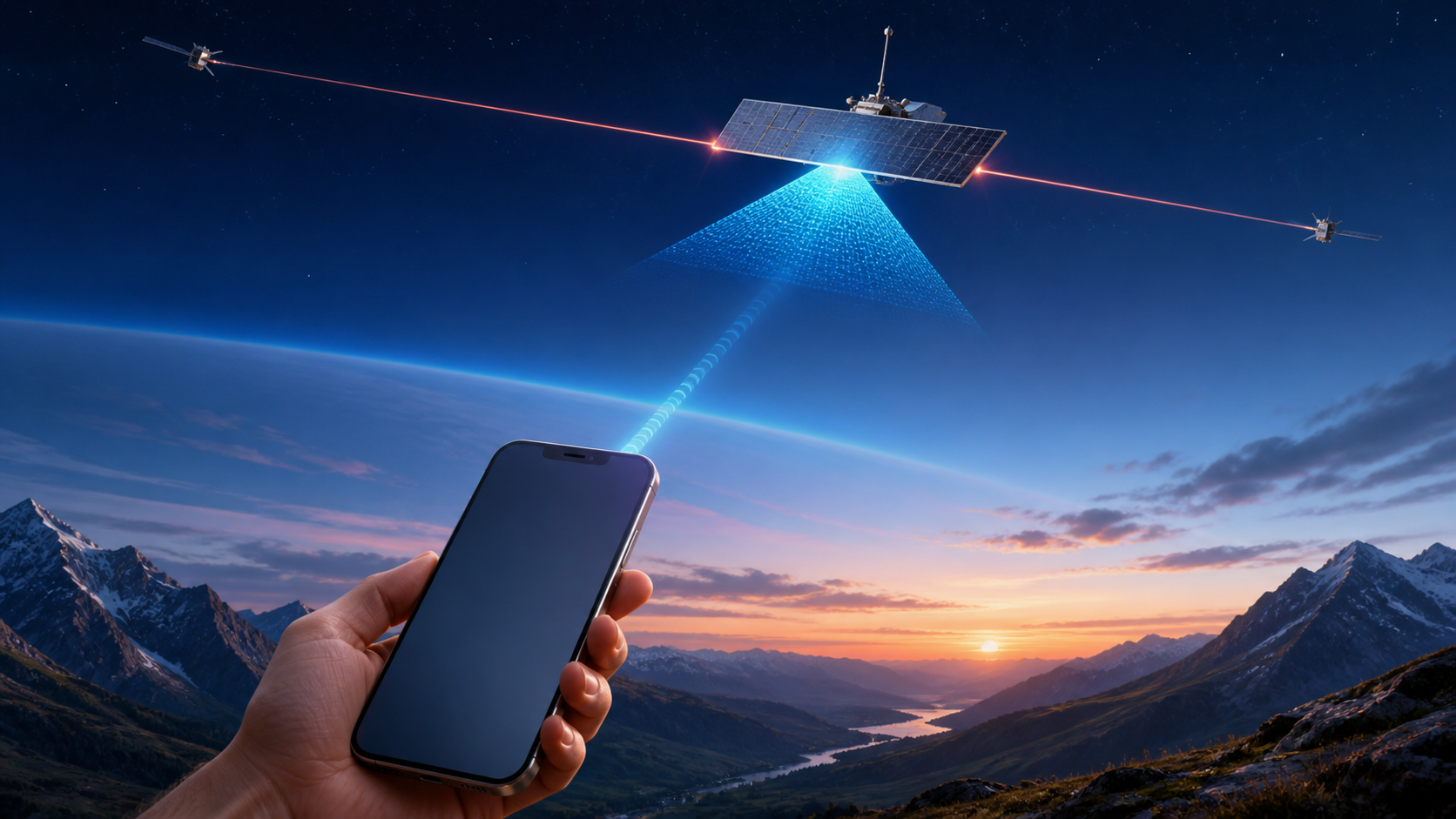
Your phone shows no signal, but a moment later it connects to a satellite moving across the sky.
There is no satellite dish, special antenna, or new app in your hand.
The same phone you use every day has just reached a cell tower in space.
This is the idea behind Starlink Direct to Cell.
It sounds simple, but making it work requires several difficult technologies to cooperate in real time.
Today, we will follow one message from a normal phone to orbit and back to Earth.
First, we need to separate two versions of Starlink that people often confuse.
Traditional Starlink provides broadband internet through a dedicated dish on a home, vehicle, ship, or aircraft.
That dish is relatively large, has a clear view of the sky, and can aim radio energy electronically.
Direct to Cell removes that dedicated dish from the user's side.
Instead, a compatible LTE phone communicates directly with a specially equipped Starlink satellite.
The phone does not suddenly become a powerful satellite terminal.
The satellite does most of the difficult work.
SpaceX describes each Direct to Cell satellite as a cell tower in space.
That description is more than a marketing metaphor.
The satellite carries an eNodeB, the equipment that performs the radio functions of a 4G LTE base station.
To the phone, the connection can therefore look like an unusual part of a familiar mobile network.
The satellite also connects with a mobile operator such as T-Mobile, KDDI, or another national partner.
It uses spectrum that phones in that country already support.
This is why an ordinary phone can connect without learning a completely new radio language.
The arrangement works somewhat like international roaming.
The satellite provides the radio connection, while the partner's core network manages the customer and service.
But there is an obvious problem: distance.
A terrestrial cell tower may be only a few kilometers from your phone.
A Direct to Cell satellite operates hundreds of kilometers above Earth.
Your phone has a small antenna and limited battery power because it was never designed to shout into space.
SpaceX approaches this link-budget problem from the satellite side.
Link budget is the engineering calculation of whether enough radio energy can survive the complete path.
The satellites fly in low Earth orbit, much closer than traditional communications satellites.
SpaceX says its current Direct to Cell satellites operate at roughly three hundred sixty kilometers.
Lower altitude reduces the distance, but it does not make the connection easy.
The satellite needs a very large and sensitive phased-array antenna.
A phased array contains many smaller antenna elements controlled together.
By changing the timing of their radio waves, the system can shape and steer a focused beam electronically.
Imagine many people pushing a swing at exactly the right moments.
Their small efforts combine into one stronger and more controlled motion.
In a similar way, the antenna elements combine their signals toward a selected area on Earth.
This electronic steering lets the satellite track coverage areas without physically pointing a dish at every phone.
Custom silicon and software then help detect signals that are extremely weak when they reach orbit.
Distance is only the first challenge.
The satellite is also moving at tens of thousands of kilometers per hour relative to the ground.
That movement changes the apparent frequency of the signal through the Doppler effect.
You hear a similar effect when an ambulance siren changes pitch as it passes you.
For a radio network, an uncorrected frequency shift can make the signal difficult to understand.
The system must predict and compensate for that shift continuously.
Movement creates another problem called handoff.
A normal cell tower stays in one place while the phone moves between coverage areas.
With Direct to Cell, the user may stand still while one satellite rises, passes overhead, and disappears.
The network must transfer the connection to the next satellite without losing the message.
This process repeats again and again as the constellation moves above Earth.
Now let us follow the data after it reaches the satellite.
The satellite does not need to send every message directly to a nearby ground station.
Starlink satellites can exchange data through optical links, often called space lasers.
These links move information across the constellation using light instead of a radio connection to Earth.
The data can travel from satellite to satellite until it reaches a useful path back to the ground.
From there, gateways and the mobile operator's core network route it toward the final recipient or online service.
The full path may therefore look like this.
Your phone sends an LTE signal to a satellite acting as a base station.
The satellite connects into the Starlink network, and laser links may carry the data across orbit.
A ground connection then passes it into ordinary mobile and internet infrastructure.
The return message follows the system in the opposite direction.
Software coordinates spectrum, authentication, routing, beam steering, Doppler correction, and handoffs along the way.
This explains why no single invention makes Direct to Cell possible.
The service depends on launch capacity, a large constellation, advanced antennas, mobile standards, and carrier partnerships.
It also explains why service begins with lighter forms of communication.
A text message contains little data and can tolerate a short delay.
A high-resolution video call needs much more capacity and a steady connection in both directions.
Each satellite beam must also share limited radio resources among the users inside its coverage area.
Direct to Cell is therefore designed first to fill dead zones, not to replace every urban cell tower.
Ground networks remain better at serving thousands of people packed into a stadium or city block.
Satellite service has other practical limits.
It works best outdoors with a broad view of the sky.
Roofs, thick trees, mountains, and tall buildings can block or weaken the path.
Connections may arrive in short windows or pause as satellites and network conditions change.
Supported apps can use limited data efficiently, but not every app will behave like it does on terrestrial 5G.
Regulation matters as much as physics because radio spectrum is licensed country by country.
SpaceX needs mobile partners and government approval before activating service in each market.
Interference must also be controlled so satellite beams do not disrupt existing terrestrial networks using nearby frequencies.
The next generation aims to improve capacity with more spectrum, stronger satellites, advanced phased arrays, and optimized 5G protocols.
Larger Starlink satellites launched by Starship could carry more powerful Direct to Cell equipment.
Even then, the central engineering trade-off will remain.
The network must deliver useful coverage from space while working within the power, antenna, spectrum, and battery limits of a normal phone.
That is what makes the technology remarkable.
SpaceX did not solve the problem by turning every phone into a satellite phone.
It redesigned the space network so an ordinary phone could continue speaking a language it already knew.
The phone sends a familiar LTE signal, but an enormous moving system meets it halfway.
That's all for today's episode.
Starlink Direct to Cell turns mobile coverage into a partnership between towers on Earth and towers moving through space.
Thanks for listening, and we'll see you next time.
Speaking practice
Speak It Out
Explain the engineering choices and limits behind satellite-to-phone service.
Recording is off. Click a question to play it.
Which technical challenge in Direct to Cell seems most difficult to solve, and why?
Click to play
Where would satellite-to-phone service be most valuable, and what limitation would matter most there?
Click to play