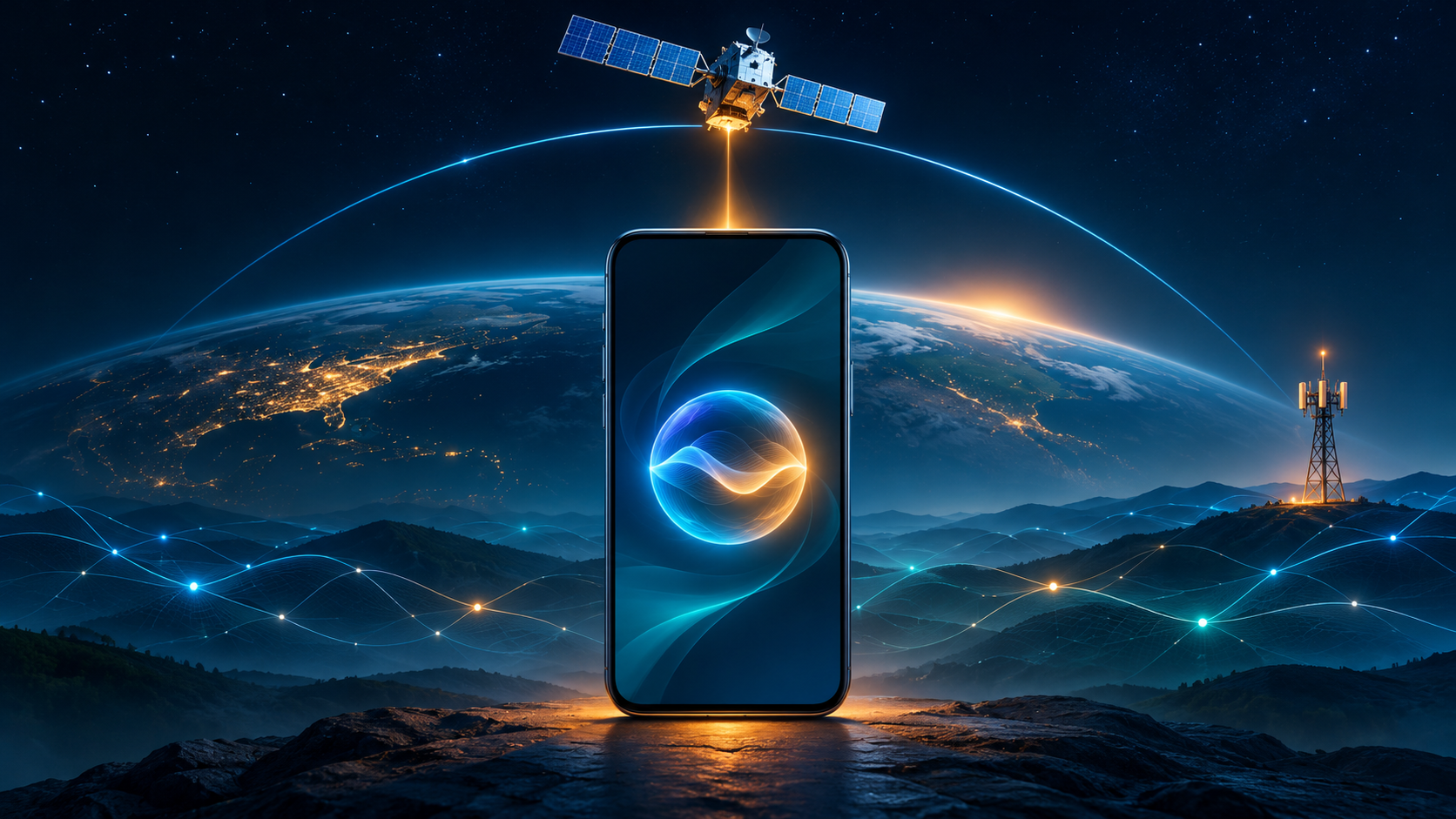
A satellite can reach your phone from space, but who controls what appears on its screen?
Big Tech & AI · EP55
Who Controls the AI Screen?
Starlink Mobile, Grok, and the race to become the first interface people use.
Free membership
Sign up free to unlock this episode.
After you log in, every lesson is 100% free — full audio, interactive transcript, expressions, and speaking practice. No paid plan.
- Unlimited access to the full episode library
- Synced transcripts and key expressions
- Save favorites and build your word list
Two newest episodes stay open for guests so you can try Atoz first.
Ready. Select a line to jump into the episode.
That question has become more interesting as SpaceX builds a larger mobile network.
The company also has access to Grok, the AI system developed by xAI, and the social platform X.
Together, those pieces suggest a possible new route to the customer.
But a route to the customer is not the same as owning the phone in your hand.
We have discussed rumors of a SpaceX phone before.
Today, let us look at a different question: who could control the next AI interface?
First, start with what SpaceX actually has.
Starlink has a large satellite network and millions of internet customers around the world.
SpaceX reported more than thirteen million Starlink consumer subscribers at the end of September.
Its direct-to-cell service is designed to connect ordinary phones through carrier partnerships.
That is powerful because customers do not need a special SpaceX handset to start using it.
It also means SpaceX still depends on existing phones and mobile operators.
Now the company wants to add more capacity on the ground.
In November, Qualcomm said SpaceX had chosen its technology for terrestrial Starlink Mobile base stations.
SpaceX plans to begin a nationwide United States rollout in 2027, according to that announcement.
The plan covers tens of thousands of sites over several years, not an overnight switch.
These are network components, not a confirmed chip deal for a SpaceX phone.
The difference matters because a network can grow without a new consumer device.
SpaceX has also discussed the challenge of reaching people inside buildings.
A satellite signal can cover open spaces, while walls and crowded cities create harder conditions.
Ground stations and carrier networks can help fill those gaps.
So the near-term project looks like a broader connection layer around existing phones.
Then comes the software question.
SpaceX acquired xAI in early 2026, bringing Grok and X into the same corporate group.
Grok can answer questions and perform AI tasks, while X offers a direct audience and distribution channel.
If connectivity, AI, and distribution work together, SpaceX could offer a more complete service.
Imagine asking an assistant to summarize an event while your connection changes between a tower and a satellite.
The user might care about a smooth answer, rather than which network carried it.
But that smooth experience still has to pass through a device interface.
This is where Elon Musk’s phrase “edge node” enters the story.
In an October 2025 interview, he described a future phone as an edge node for AI processing.
In plain language, some AI work would happen on the device and some would happen in remote servers.
That could reduce the amount of data sent back and forth and make an assistant feel more immediate.
Musk also said he was not working on a phone in that interview.
His description was a vision of computing, not a product launch.
Why does the location of AI processing matter?
A device that understands requests directly might replace some of the app menus we use today.
Instead of opening three apps, you might ask one assistant to plan a trip and share the result.
The assistant could become the first place you go, even while other services work behind it.
That makes the interface valuable, not just the connection underneath.
Apple and Google already control the main mobile operating systems and their app stores.
They also shape default services, permissions, and how outside assistants reach users.
From SpaceX’s point of view, that could limit how much of the customer experience it controls.
That is a strategic inference, not an announced SpaceX plan to replace either operating system.
There are several possible paths from here.
The simplest is to make Grok and Starlink Mobile work well on iPhones and Android phones.
That reaches existing customers quickly, although the platform owners keep important rules.
A second path would be an optional AI device that connects to services people already use.
A third path would be a full competing phone and operating system.
That would be much harder because it needs apps, manufacturing, support, privacy controls, and trust.
None of those device paths has been confirmed as a SpaceX product today.
There is also a risk in connecting so many layers under one company.
Customers may welcome a useful assistant, but they will ask what data it collects and how it is protected.
Mobile service also depends on spectrum rights, local approvals, and reliable indoor coverage.
A satellite network alone cannot erase those practical limits.
So what should we watch over the next year?
Watch whether Starlink Mobile can turn today's limited app data into reliable everyday broadband.
Watch how well Grok works across existing phones, and whether it becomes a default choice for anyone.
And watch for an actual device announcement, rather than a sketch or a rumor.
The most interesting contest may be for the first answer a user sees on a screen.
SpaceX has pieces of the network and AI stack, but Apple and Google still hold the main mobile platforms.
The next chapter will show whether those pieces can become a compelling interface for ordinary people.
That's all for today's episode.
The network is expanding, but control of the AI screen remains an open question.
Thanks for listening, and we'll see you next time.
Speaking practice
Speak It Out
Think about the future of mobile AI.
Recording is off. Click a question to play it.
Would you prefer an AI assistant built into your current phone or a separate AI device, and why?
Click to play
What would make you trust a company that provides your mobile network and your AI assistant?
Click to play
Key Expressions
a route to the customera way to reach and serve users
analytical
- business strategy
- product distribution
A route to the customer is not the same as owning the phone.
fill those gapssolve the remaining areas of missing coverage
practical
- network coverage
- service design
Ground stations can help fill those gaps.
an open questionsomething not yet settled by evidence
thoughtful
- technology forecasts
- market analysis
Control of the AI screen remains an open question.