Mars is close enough to dream about and far enough to punish every mistake.
Science & Future · EP35
Can Humans Really Live on Mars?
Mars is not only a travel problem. It is a test of radiation protection, health, power, water, and reliable life support.
Free membership
Sign up free to unlock this episode.
After you log in, every lesson is 100% free — full audio, interactive transcript, expressions, and speaking practice. No paid plan.
- Unlimited access to the full episode library
- Synced transcripts and key expressions
- Save favorites and build your word list
Two newest episodes stay open for guests so you can try Atoz first.
Ready. Select a line to jump into the conversation.
Could humans really live there?
The honest answer is: perhaps one day, but not with the systems we have proven today.
Getting people to Mars is only the opening problem.
Keeping them healthy, supplied, and able to return is the harder one.
A trip can take many months, and launch windows do not appear whenever we want them.
Once a crew leaves Earth, fast rescue is impossible.
Mars has thin air, intense cold, and almost no global magnetic shield.
That means radiation becomes a daily design problem, not a rare emergency.
Solar storms can deliver sudden bursts of dangerous particles.
Cosmic radiation arrives quietly from beyond our Solar System.
Water, food, and protective material may need to become part of the shelter itself.
Timing also matters: ESA research suggests some parts of the solar cycle may reduce deep-space radiation exposure.
But better timing does not remove the risk.
The human body faces another challenge before it even lands.
Long periods in microgravity affect muscles, bones, circulation, vision, and the way fluids move through the body.
Mars gravity is stronger than the Moon's but far weaker than Earth's.
We do not yet know every consequence of living for years in that environment.
Exercise can slow bone and muscle loss, but exercise equipment also consumes mass, power, and crew time.
Medicine creates a different kind of uncertainty.
On Mars, a doctor cannot send a patient to a nearby hospital or order a replacement organ within hours.
Communication with Earth can take many minutes in each direction.
That delay makes real-time remote control and ordinary video consultation impossible during urgent moments.
A crew must diagnose injuries, repair equipment, and make difficult decisions with limited help.
Isolation also changes the mission.
The same small group may live and work together for years inside a noisy, confined habitat.
Privacy, sleep, leadership, and conflict management become parts of the engineering plan.
Then there is the home.
A Mars habitat must make oxygen, recycle water, manage waste, store food, and provide reliable power.
Every pipe, filter, battery, and software system needs a backup.
On Earth, a broken pump is an inconvenience.
On Mars, it can become a mission-ending problem.
Food presents another long-term test.
Stored meals lose quality over time, while crops need light, water, nutrients, and protection from contamination.
A greenhouse may improve food and morale, but it adds more systems that can fail.
Early crews will probably carry most calories from Earth and grow only selected fresh foods.
Martian dust is another serious concern.
It is fine, abrasive, and chemically unusual.
NASA is still working to define safe exposure limits for crews.
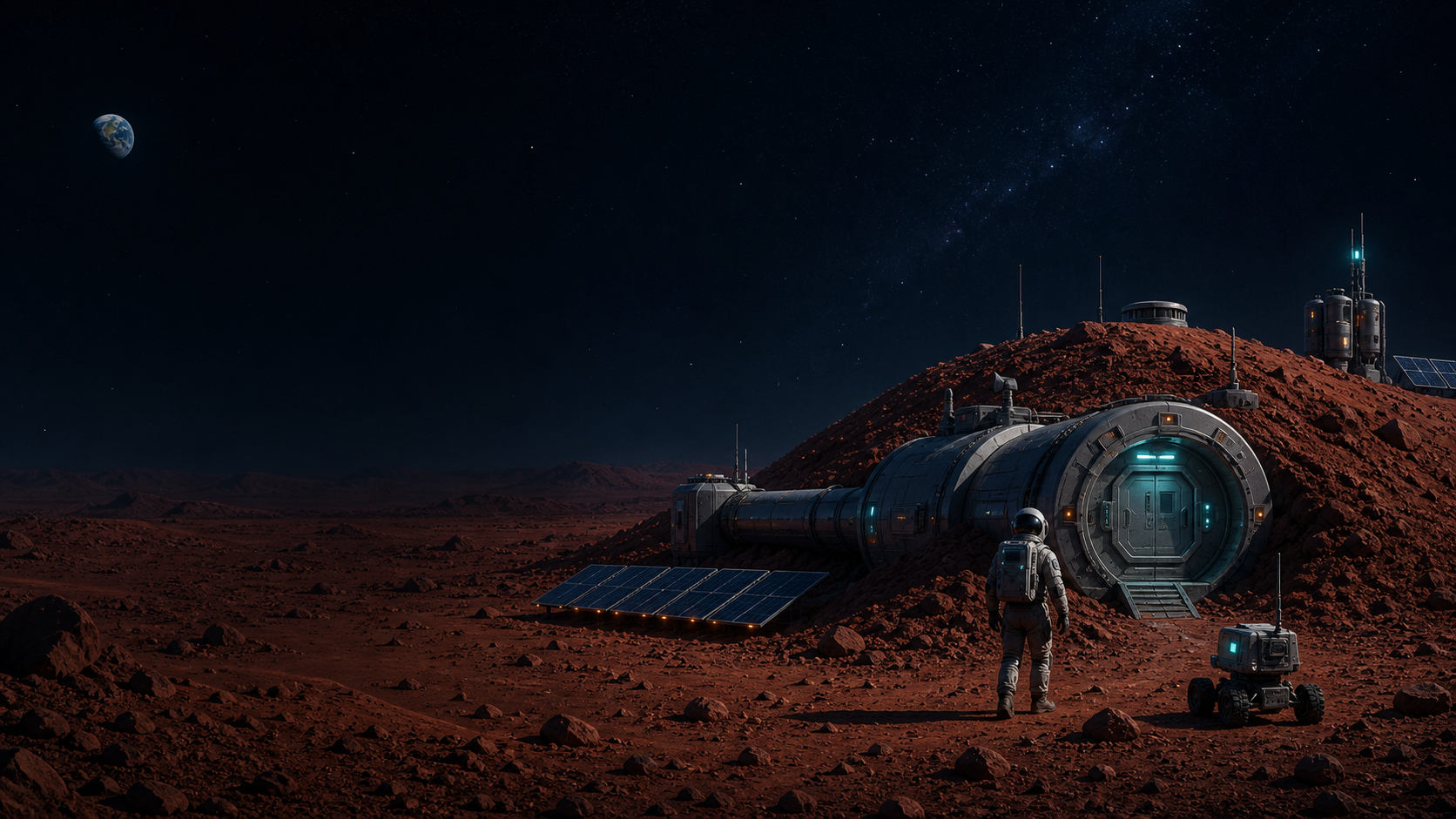
The best early homes may be partly underground or covered with local soil.
That could help with radiation, temperature changes, and dust storms.
Robots would probably prepare much of the site before people arrive.
They could test water, build landing areas, move equipment, and verify power systems.
Local resources could reduce what must be launched from Earth.
Subsurface ice may provide drinking water, oxygen, and eventually fuel ingredients.
Carbon dioxide in the atmosphere may also become a useful raw material.
But finding a resource is not the same as producing it reliably through a Martian winter.
Power must continue through dust, darkness, maintenance, and equipment failure.
Solar arrays may need large storage systems, while nuclear power brings its own transport and safety questions.
This is why living on Mars is less like building a distant city and more like operating a tiny life-support company.
The most realistic first step is not a million-person colony.
It is a small crew, a carefully protected habitat, and repeated missions that learn from failure.
Humans may visit Mars before they truly live there.
There is also an ethical question.
Humans and their microbes could contaminate places that may preserve evidence of ancient life.
Exploration must protect scientific sites while keeping crews safe.
Permanent life will depend on whether we can turn local ice, sunlight, and soil into dependable systems.
So can humans live on Mars?
Physics does not say no.
But engineering, biology, and time still have to say yes.
That's all for today's episode.
Mars may become a home only when survival stops depending on a perfect day.
Thanks for listening, and we'll see you next time.
Speaking practice
Speak It Out
Think about what a permanent Mars home would require.
Recording is off. Click a question to play it.
Which challenge would be hardest for a Mars crew to solve, and why?
Click to play
Should humans build a permanent settlement on Mars before every major health risk is understood? Explain your view.
Click to play