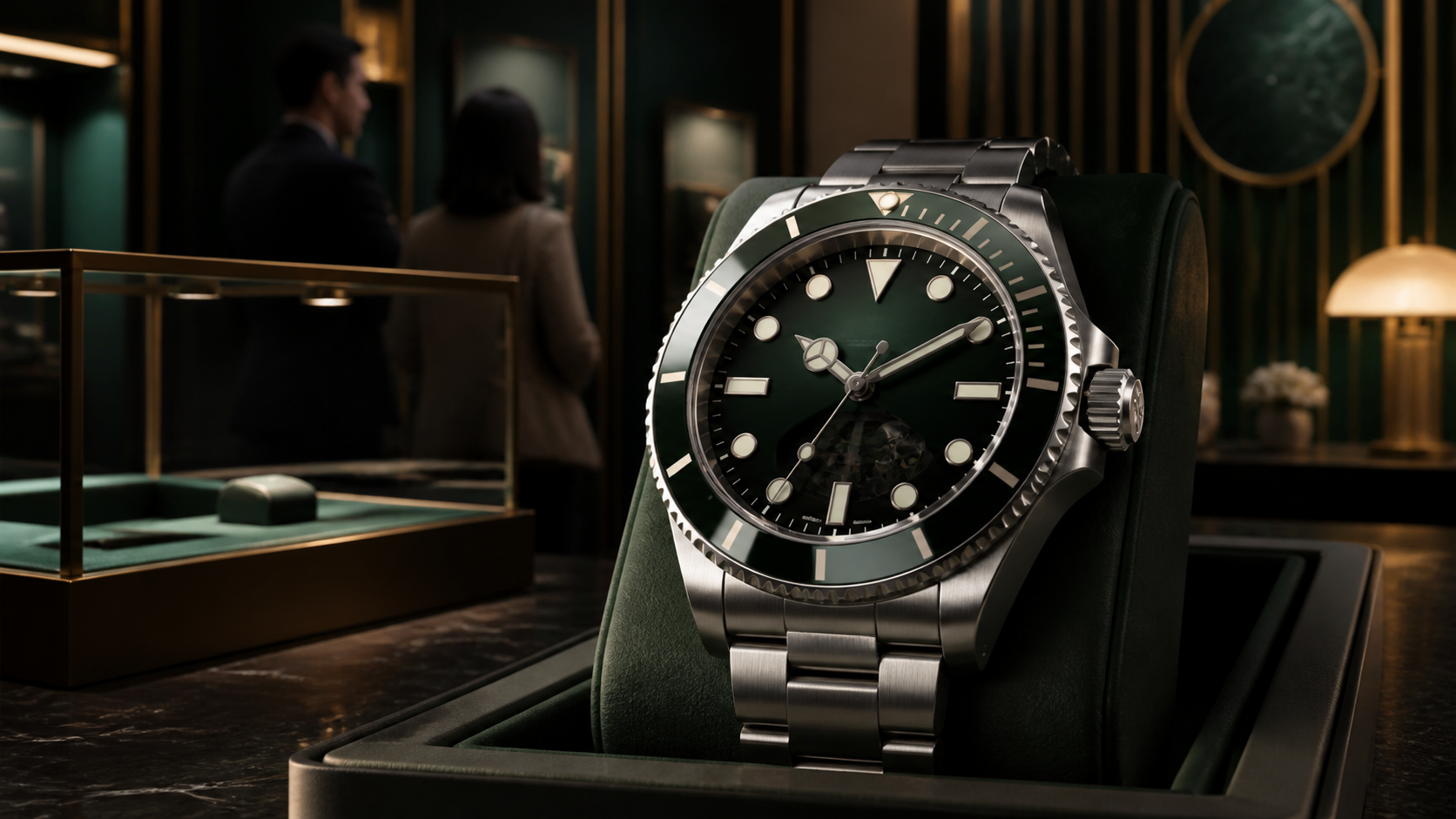
Imagine walking into a luxury watch store with enough money to buy the watch you want.
Why Series · EP41
Why Series: Why Is a Rolex So Hard to Buy?
How engineering, retailer allocation, scarcity, and the resale market turned a mechanical watch into a difficult purchase.
Free membership
Sign up free to unlock this episode.
After you log in, every lesson is 100% free — full audio, interactive transcript, expressions, and speaking practice. No paid plan.
- Unlimited access to the full episode library
- Synced transcripts and key expressions
- Save favorites and build your word list
Two newest episodes stay open for guests so you can try Atoz first.
Ready. Select a line to jump into the conversation.
The display cases are polished, the staff is welcoming, and yet the answer is still no.
The most popular Rolex models may not be available, and nobody can promise exactly when they will arrive.
That strange experience raises a simple question.
Why is a Rolex so hard to buy?
The answer begins with real engineering, but it also involves distribution, status, trust, and a powerful secondhand market.
Rolex did not become famous by starting as a symbol of wealth.
Its early reputation was built around solving practical problems with wristwatches.
In the early twentieth century, many people still trusted pocket watches more than small watches worn on the wrist.
Wristwatches faced dust, moisture, shocks, and constant movement.
Rolex founder Hans Wilsdorf believed that a wristwatch could be both precise and dependable.
In 1926, the company introduced the Oyster, a case designed to keep water and dust away from the movement.
The case used tightly secured parts to form a protective shell around the delicate mechanism.
A year later, swimmer Mercedes Gleitze wore an Oyster while crossing the English Channel.
The watch remained in working condition after more than ten hours in cold seawater.
That event was both a technical test and a brilliant piece of marketing.
Rolex was not only telling customers that the watch was waterproof.
It was proving the claim in a dramatic public setting.
Another major step arrived in 1931 with the Perpetual rotor.
This mechanism uses the natural movement of the wrist to wind the watch automatically.
The rotating weight transfers energy to the mainspring, which powers the movement.
Less manual winding also means less frequent use of the crown, helping the case remain sealed.
These inventions created an important promise: a mechanical watch that could survive everyday life.
Over time, Rolex connected that promise to diving, racing, aviation, exploration, and professional work.
Models such as the Submariner, Daytona, and GMT-Master became easy to recognize across generations.
Their designs changed slowly, so an older watch could still look connected to a new one.
That consistency helped Rolex build something more valuable than a fashionable product.
It built trust in a visual language.
Today, the company controls much of its manufacturing and tests completed watches for precision and reliability.
New watches purchased through official jewelers receive a five-year international guarantee.
Quality control takes time, and Rolex says its standards naturally restrict production capacity.
The company also says demand can exceed that capacity for certain models.
But limited production is only the first part of the shortage story.
Rolex does not sell most new watches directly to customers through a normal online store.
Instead, new watches are distributed through a global network of official jewelers.
Those independent retailers receive regular deliveries and manage allocation to customers themselves.
This means there is no single worldwide waiting list controlled by Rolex.
One store may know a customer well, while another may be meeting that person for the first time.
Retailers often want popular watches to reach buyers who will keep them rather than immediately resell them.
However, allocation practices are not perfectly transparent, and experiences can differ from store to store.
The result feels less like ordering a product and more like being selected for an opportunity.
That uncertainty can be frustrating, but it can also increase desire.
Behavioral economists call this a scarcity effect.
When access is limited, people may judge an object as more valuable simply because it is difficult to obtain.
A long wait also turns the purchase into a story about patience, access, and achievement.
The watch becomes proof that the buyer reached a rare moment, not only proof that they had enough money.
This is where the secondhand market changes everything.
A buyer who cannot find a new watch at retail may be able to purchase one immediately from a dealer or collector.
The tradeoff is price.
Highly desired steel sports models can sell above their official retail prices, while less popular models may not.
That premium sends a visible message that market demand is stronger than store supply.
It also attracts speculators who hope to buy at retail and quickly sell for a profit.
During the pandemic-era luxury boom, prices for many collectible watches rose sharply.
Cheap money, online trading, limited travel, and a search for alternative assets all supported demand.
Prices later corrected, showing that a famous watch is not a guaranteed investment.
The WatchCharts Rolex Market Index was higher over the year in August 2026, but remained below its level five years earlier.
That mixed record is more useful than the simple claim that every Rolex always rises in value.
Condition, reference, materials, production changes, paperwork, and timing can all affect resale prices.
Transaction costs and dealer margins can also reduce or erase an apparent gain.
A watch may preserve value better than many luxury products, but it does not behave like cash in a bank account.
Rolex has responded to the secondhand market with its own Certified Pre-Owned program.
Eligible watches sold by participating official retailers are authenticated, serviced, and given a new two-year guarantee.
For the buyer, this reduces uncertainty about authenticity and mechanical condition.
For Rolex, the program extends the official brand experience into a market that previously operated mostly outside its control.
It also creates an unusual situation.
A certified used watch may be immediately available even when a new version is difficult to obtain.
The customer is therefore choosing among price, waiting time, condition, and official reassurance.
So, is the shortage entirely manufactured?
There is no solid public evidence that every empty display case is part of one simple plan to withhold watches.
Rolex points to labor-intensive production and exceptional quality standards, while demand remains concentrated in a few famous models.
At the same time, the distribution system clearly protects exclusivity and prevents unlimited instant access.
The most accurate answer is that engineering limits, selective distribution, collector behavior, and social status reinforce one another.
Each force makes the others stronger.
The technology creates trust, the design creates recognition, and scarcity creates urgency.
The resale market then converts that urgency into a visible price.
This explains why Rolex is difficult to copy as a business, even though many companies can make excellent mechanical watches.
Competitors may match one feature, but Rolex combines product reliability, cultural recognition, controlled distribution, and resale liquidity.
For a buyer, the best question may not be whether a Rolex is worth the premium to everyone.
The better question is what part of the premium matters personally: the engineering, the history, the design, the status, or the possibility of resale.
If the main goal is investment profit, the risks deserve the same attention as the success stories.
If the goal is ownership, waiting may be easier when the buyer genuinely likes the watch rather than its market price.
That's all for today's episode.
A Rolex is hard to buy because it is more than a product; it is a carefully maintained system of technology, trust, and scarcity.
Thanks for listening, and we'll see you next time.
Speaking practice
Speak It Out
Think about scarcity, luxury, and buying decisions.
Recording is off. Click a question to play it.
Does limited availability make a luxury product more attractive to you, or less attractive? Explain why.
Click to play
Which matters more in a luxury watch: engineering, history, status, or resale value? Support your choice.
Click to play